 SW-03 · Adhesives & Underlayment
Over concrete, several guides call for a 6 mil polyethylene vapor barrier under floating vinyl plank; National Flooring Products requires it on and below grade, overlapped 12 inches and taped.1 2 Planks with an attached closed-cell pad often allow nothing more underneath.3 4 In wet rooms, the edges matter more than the pad: seal flanges and tubs with silicone.5 6
Rigid vinyl plank is sold as waterproof, and the plank itself usually is. The floor is a different matter. Water can get under a floating floor at its edges, and moisture can rise into it from a slab or a crawl space. In kitchens, baths and laundry rooms, the underlayment and the details around it decide whether that water causes a problem. The installation guides are specific about both.
Over concrete: a vapor barrier
Concrete gives off moisture, and a floating floor traps it. Several guides call for a polyethylene sheet between them. Timeless Designs recommends a 6mil vapor barrier underlayment over concrete for all floating vinyl plank installations.2 National Flooring Products requires a 6 mil plastic vapor barrier on below- and on-grade concrete or gypcrete, overlapped 12” and taped with moisture-proof tape. It says failing to do so voids all manufacturer warranties.1 It recommends the same barrier above grade.1 Elite describes film barriers of at least 6 mil polyethylene with 6” to 8” sealed overlaps and moisture-resistant tape.3
A barrier is not a cure for a wet slab. Timeless says concrete with excess moisture results needs a moisture mitigation system.2 Test first; see moisture testing.
Attached pads: check before adding anything
Many rigid planks now carry an attached pad. MSI describes the pre-attached underlayment on its rigid core line as IXPE, a closed-cell backing that is 100-percent waterproof.6 Some makers limit what else can go under such planks. Elite says its click end joints are designed to work with its attached pad, and it does not warrant the product with an additional pad underneath.3 Marquis says additional underlayment may not be installed under products with attached cushions.4 EverStep, for its own product, recommends any underlayment be nothing thicker than 1.5 mm.7
Whether a polyethylene sheet over concrete counts as underlayment varies by maker. Read the guide for the product. If it calls for a vapor barrier under an attached-pad plank, it will say so.
What an underlayment's sheet tells you
Underlayments for wet areas usually list a vapor permeance. Roberts gives its acoustic underlayment's water vapor permeance as 0.111 lbs/1000 ft²/24 hrs by ASTM E96, and describes a closed-cell polypropylene foam.8 It uses an adhesive strip and an overlap film to join rolls into a continuous moisture barrier.8 A low permeance and taped seams are what make a pad act as a barrier. An open-cell pad with untaped seams does not, whatever it is called.
Crawl spaces and framed floors
Kitchens and baths over crawl spaces take moisture from below. Huber, a subfloor maker, warns that vinyl over an unconditioned crawl space in warm, humid climates can trap moisture, and cause bubbling, warping or cupping.9 The guides address the crawl space itself. Timeless requires the ground to be covered with 6- mil polyethylene sheeting.2 Daltile asks for the ground to be completely covered with 6 mil polyethylene, with at least 18” of clearance.5 National Flooring Products requires seams in the crawl space plastic overlapped 18” and sealed.1 An underlayment under the plank does not fix a wet crawl space. See moisture barriers below grade.
Water from above: the edges
In wet rooms, most water reaches the subfloor at the edges. MSI says vinyl edges exposed to a toilet flange or shower edge must be sealed with silicone caulk, to stop water building up under the floor.6 Daltile asks for expansion space around the toilet flange, sealed with a premium waterproof 100% silicone caulk, and says not to anchor the toilet through the flooring.5 Elite does not approve acrylic caulk; silicone stays flexible so the floor can still move.3 Leave the expansion gap, then seal it with the flexible caulk the guide names. See click-lock vinyl in bathrooms.
Kitchens and appliances
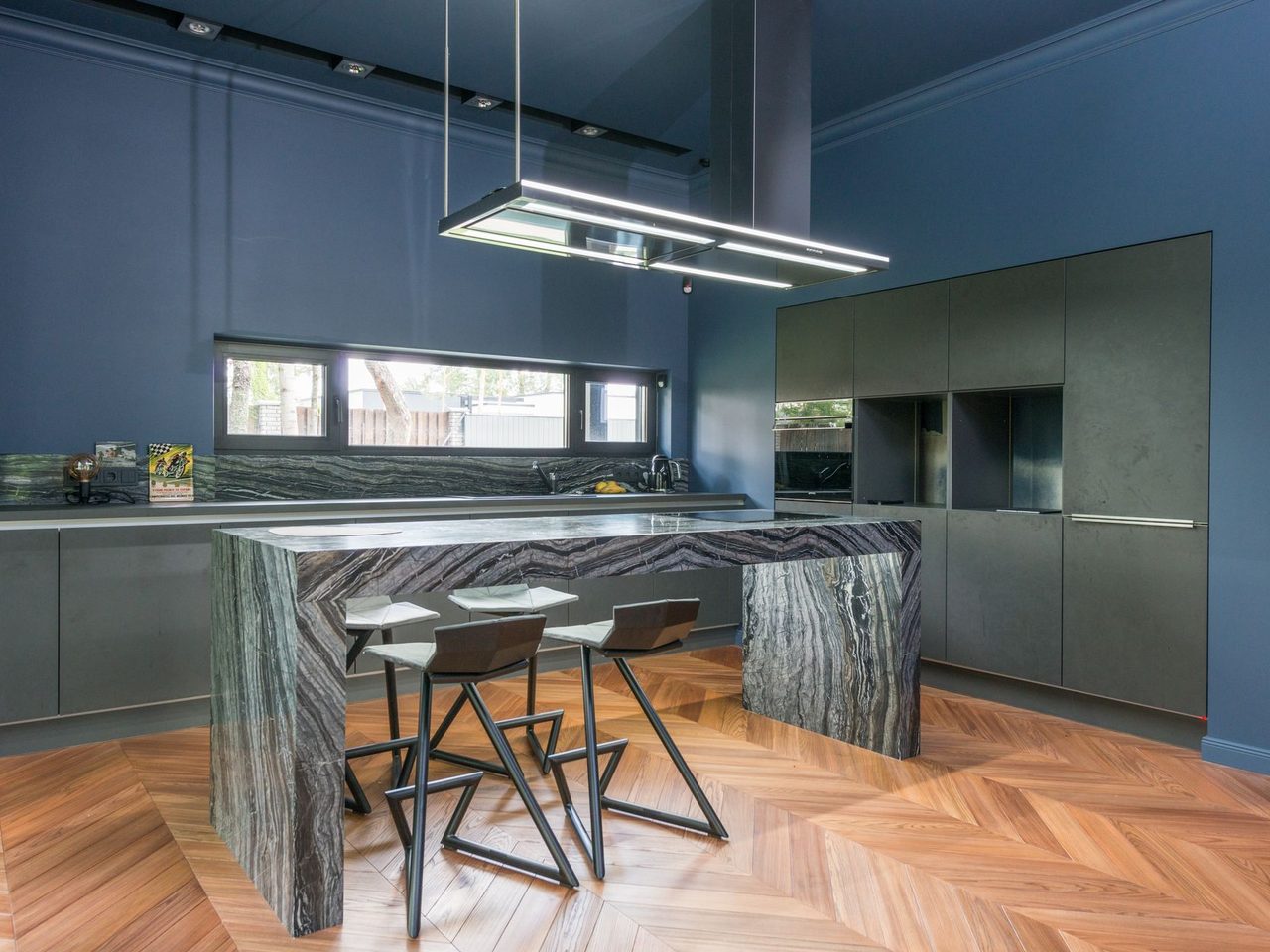
Kitchens add appliances that leak and cabinets that pin the floor. Mohawk's warranty excludes damage from appliance or plumbing leaks.10 Its waterproof warranty covers topical water, not moisture from below or flooding.10 Lay the floor where the guide allows, usually up to the cabinets rather than under them. Give the dishwasher and refrigerator lines a clear path to be checked. See vinyl plank under appliances.
Commercial wet rooms: often glued, not floated
In commercial kitchens, restrooms and healthcare wet areas, plank is often glued down rather than floated, and the adhesive becomes the moisture system. EverStep's glue-down instructions limit moisture to 3 lbs. per 1,000 square feet in 24 hours by ASTM F1869. Relative humidity must be no more than 80% RH by ASTM F2170, before, during and after installation.11 It notes those limits apply only with its named transitional adhesive.11 It also holds the area at 65° to 85° F and 30% to 60% relative humidity for 72 hours before, during and after installation.11 FloorFolio names a separate adhesive for areas with heavy rolling loads or moisture conditions.12
The lesson is the same as for floating floors. The limits are tied to a specific product and adhesive, and a substitute changes them. Specify the adhesive with the plank, and test against the numbers that adhesive allows. See glue-down adhesive mistakes.
A wet-room checklist
- Test the slab; mitigate if results exceed the limits.
- Install the vapor barrier the guide requires, with the overlaps and tape it names.
- Use the attached pad as made; add nothing the plank maker has not approved.
- Fix crawl space moisture at the ground, not under the plank.
- Seal flanges, tubs and showers with flexible silicone over the expansion gap.
Sources
- NFP, “Architect’s Choice LVP Installation Guide”. my-nfp.com/resource/architects-choice-lvp-installation-guide
- Timeless Designs, “Click Floating Luxury Vinyl Installation Instructions”. timelessdesignsflooring.com/wp-content/uploads/2023/05/TD-Rigid-Core-Ins
- Elite Flooring, “Välinge Installation Guide (Woodlands)”. eliteflooringusa.com/links/install-instructions/Elite-Installation-Guide
- Marquis Industries, “Rigid Vinyl Plank Installation Instructions (Angle)”. marquisind.com/static/resources/Angle_Angle%20Installation%20Instruction
- Daltile, “ProSeries Luxury Vinyl Flooring Installation & Care Guide (Rigid Core Click, Glue Down)”. s1.img-b.com/build.com/mediabase/specifications/daltile/1996309/daltile-
- MSI Surfaces, “Installing Luxury Vinyl Flooring in the Bathroom”. msisurfaces.com/blogs/post/2019/11/26/installing-luxury-vinyl-flooring-i
- EverStep Flooring, “LVP Click Lock Installation Guidelines”. everstepflooring.com/lvp-click-installation-guidelines/
- Roberts Consolidated, “AcoustiShield Underlayment sample sheet”. robertsconsolidated.com/wp-content/uploads/2026/05/70-113_AcoustiShield-
- Huber Engineered Woods, “Four Ways to Prevent Moisture Damage Under Luxury Vinyl Flooring | Huber Engineered Woods”. huberwood.com/blog/four-ways-to-prevent-moisture-damage-under-luxury-vin
- Mohawk (via Lowe's), “LVT/LVP Residential Limited Warranty”. pdf.lowes.com/warrantyguides/842374006031_warranty.pdf
- EverStep Flooring, “LVP Glue Down Installation Guidelines”. everstepflooring.com/technical/lvp-glue-down-installation-instructions/
- FloorFolio, “Installation Guide 2025”. floorfolio.com/wp-content/uploads/2025/FloorFolio-Installation-Guide-202
General information for the flooring trade. This article was drafted with AI assistance and checked against the sources listed above; the manufacturer's current instructions and the project specification govern any real job. If something here is wrong or out of date, tell us.