 SW-03 · Carpet & Soft Flooring
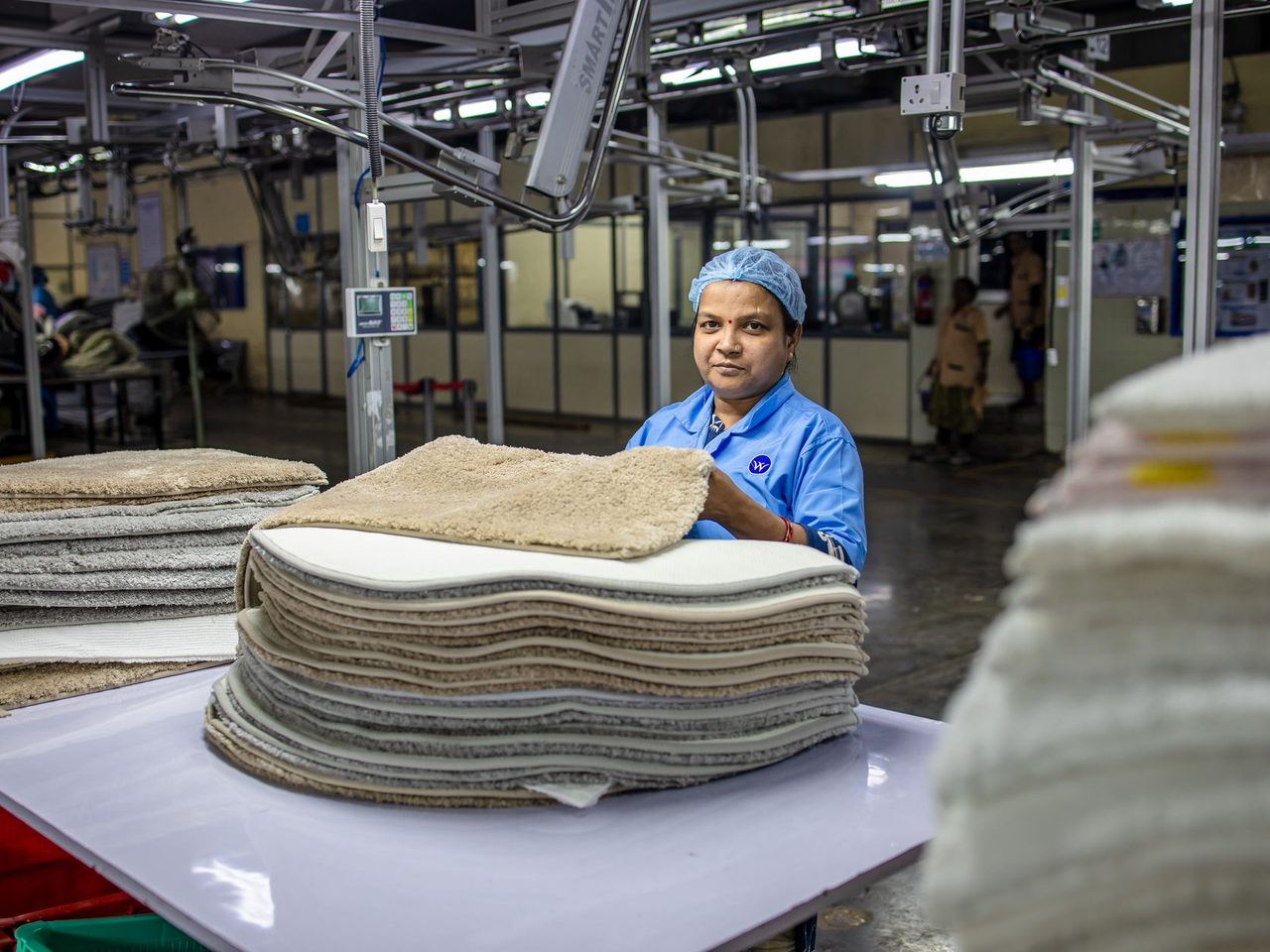
Hardback carpet tiles typically use filled bitumen or filled polyolefin; the backing keeps the tile stable but does not compress, so the fibers take the impact.1 Cushion backings absorb footfall, add sound absorption and comfort, and Milliken reports higher impact sound ratings for its cushion options.2 Felt backings start soft but can compress over time.1 Match the backing to traffic, acoustics and how often tiles will be lifted.
Carpet tile is chosen for offices, schools and hospitality because it can be laid in a pattern, lifted for access and replaced a tile at a time. What makes that possible is the backing. It holds the tile flat and stable, resists curling, and decides how the tile behaves underfoot. The main families are hardback, cushion and felt. Each has a place, and the wrong choice shows up as wear, noise or tiles that will not lie flat after they are lifted.
What the backing does
Milliken describes carpet backing as the underside of a carpet tile, adding strength and stability and securing the tufts.2 It usually has several layers: a primary backing that holds the yarn, and secondary layers for extra support.2 It notes that the right backing keeps the tile dimensionally stable and flat on the floor, and can add acoustic, insulation and sustainability benefits.2
Hardback: bitumen and polyolefin
Milliken explains that hardbackings are typically made of filled bitumen compounds or filled polyolefins. The hardback gives the tile stability on the floor, but offers no additional benefits.1 Because it does not compress under footfall, the carpet fibers absorb the impact directly. That causes visible wear and traffic lanes sooner than cushion or felt backings would.1 The dense, non-porous backing also gives little acoustic benefit, reflecting sound back into the room.1
Hardback remains the entry-level choice for a reason: it is stable, simple and lower in cost. Milliken lists its own hardback with an average impact sound rating of 25 dB, a Class 33 heavy commercial wear rating and a 10 year wear warranty.2 It suits areas where budget leads and comfort and acoustics matter less.
Cushion backing
Cushion backings add a resilient layer under the tile. Milliken describes open cell cushion made from recycled polyurethane, with an interconnected network of air pockets that compress under footfall and then recover.1 That protects the fibers and keeps performance over time, it says.1 Its cushion options are listed with average impact sound ratings of 29 to 33 dB and 33 to 37 dB, against 25 dB for its hardback.2 It lists 90% recycled content in the cushion, and longer wear warranty terms: 12 and 15 years.2
Milliken also addresses a common shortcut. It argues that a hardback tile over a separate cushion underlay adds installation cost and time, and complicates underfloor access. Both layers have to come up, and misalignment between them can show at the seams.1
Felt backing
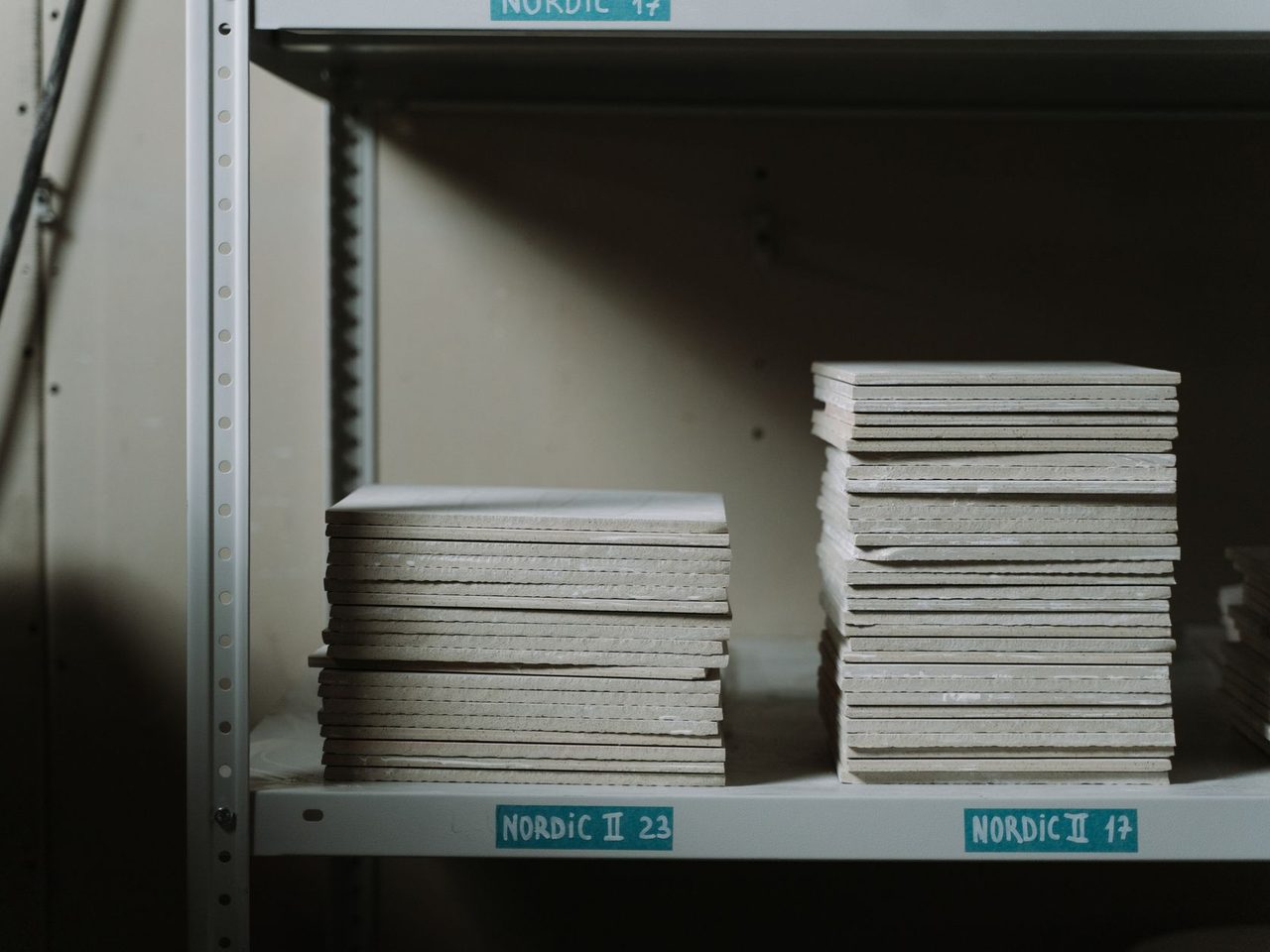
Felt is a textile backing of mechanically entangled fibers, often from recycled material such as recycled PET bottles.1 At first, the trapped air compresses under footfall, absorbing impact and sound.1 Milliken warns that over time the felt can compress and lose thickness, along with some of its acoustic and wear benefits. In high-traffic areas this can happen faster, leaving uneven tile thickness.1 It notes a practical consequence for access floors. Tiles that are lifted and not returned to their original places can create an uneven floor and highlight seams.1
Backings and installation
The backing also decides how a tile is fixed. Interface designs some of its bio-based backings for spray adhesive or for free-lay installation within a stabilization grid of tackifier.3 It specifies a tackifier applied in a 100 mm band on a 2 m grid for those products.3 Milliken makes a backing designed to be installed with no adhesive at all.4 It describes that backing as containing no PVC or plasticizers.4 The CRI 104 standard says modular carpet adhesive is a pressure-sensitive type for releasable installation, and that adhesive recommendations differ with the backing.5 Never assume the adhesive from one tile works for another.
Site conditions the backing needs
Whatever the backing, the floor under it has to be right. Interface asks for new concrete to be fully cured and sealed, with humidity not exceeding 75% by hygrometer test.3 It asks for an efficient damp proof membrane in solid floors at or below ground level, or wherever moisture may rise.3 Tiles must be conditioned in their boxes for at least 24 hours at a minimum of 18°C (64°F) before laying.3 Over heated floors, Interface allows a surface temperature up to 27°C (80°F), with the heating off 48 hours before installation.3 Milliken sets 28°C for its modular carpet.4 A backing that is stable at room temperature can still move on a wet or hot slab. Treat those limits as part of the backing choice, not an afterthought.
Accessibility
Where carpet tile is on an accessible route, the backing is part of the requirement. The 2010 ADA Standards require carpet or carpet tile to be securely attached, with a firm cushion, pad or backing, or no cushion or pad.6 They limit pile height to ½ inch maximum.6 A soft, thick cushion system may need checking against that language.
Choosing a backing
Start from the space, not the product. Ask how much traffic it gets, whether noise is a complaint, how often tiles will be lifted for access or replacement, and what the budget allows over the floor's life rather than on the day of purchase. Then compare backings on those terms.
- High traffic, tight budget: hardback, with a fiber and construction that hide wear.
- Open offices, education, hospitality: cushion backing for acoustics and comfort.
- Raised access floors: a backing that recovers its thickness, so lifted tiles go back level.
- Sustainability targets: check recycled content and the EPD; see EPDs and HPDs.
- Every case: use the adhesive or fixing system the manufacturer names for that backing.
Sources
- Milliken, “What are the different types of carpet tile backing?”. europeblog.milliken.com/4-myths-of-open-cell-cushion-backing
- Milliken, “Product Backings (commercial carpet backing options)”. milliken.com/en-gb/businesses/floor-covering/technical/product-backings
- Interface, “Carpet Tile Installation Instructions”. interface.com/content/dam/interfaceinc/interface/technical/emea/installa
- Milliken, “Modular Carpet Installation Guidelines”. contenthub.milliken.com/api/public/content/212b9643130e469aa098eefd05147
- Carpet and Rug Institute, “CRI 104 Standard for Installation of Commercial Carpet”. carpet-rug.org/wp-content/uploads/2019/03/CRI-104-STANDARD-For-INSTALLAT
- U.S. Access Board, “ADA Accessibility Standards”. access-board.gov/ada/#ada-303
General information for the flooring trade. This article was drafted with AI assistance and checked against the sources listed above; the manufacturer's current instructions and the project specification govern any real job. If something here is wrong or out of date, tell us.