 SW-03 · Adhesives & Underlayment
Use the adhesive the flooring maker names for radiant heat; most warranties exclude problems from non-recommended adhesive.1 Keep the surface at or below 85°F.2 FloorFolio turns the heat down or off for 48 hours before installation so the subfloor stays under 65°F while the adhesive goes down, then raises it gradually.2 Sustained heat can soften some adhesives, so the limit matters for the life of the floor.3
Luxury vinyl tile glued over radiant heat is common in bathrooms, entries, healthcare and hospitality. Contractors often ask which glue holds best. The honest answer is that the adhesive is decided by the flooring maker, not by preference. What decides whether it holds is how the installation handles heat: before, during and after the adhesive cures. The guides are consistent on that.
Use the adhesive the flooring maker names
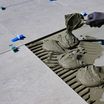
Flooring warranties are written around specific adhesives. Mohawk's residential vinyl warranty excludes problems caused by non-recommended adhesive.1 FloorFolio tells installers to use only its own adhesives.2 EverStep's glue-down moisture limits apply only when its named transitional adhesive is used.4 Elite recommends specific pressure-sensitive adhesives, or equivalents, for full-spreading its SPC.5 So the first question is not which glue is strongest. It is which glue the flooring's guide approves over radiant heat, for this substrate.
Daltile's guide lists its own universal adhesives and trowels for full spread, by product type.6 Its adhesive and trowel selection depends on whether the plank has a dry back or an attached pad.6 An adhesive approved for one construction may not suit another.

The temperature ceiling
Radiant floors under glued vinyl share the same limit as floating floors. FloorFolio allows installation over radiant heat provided the operating temperature does not exceed 85°F.2 EverStep lists radiant heated subfloors not exceeding 85°F (29°C) among its acceptable substrates for glue-down.4 Mohawk says radiant heat must not exceed 85º F.1
The ceiling protects the adhesive as well as the vinyl. Continental Flooring notes that some adhesives may soften or lose grip strength under sustained heat above 95°F, leading to loose tiles or shifting planks.3 It warns that traditional cutback adhesives used with VCT can soften and lose bond strength under sustained heat above 95°F, especially in areas with radiant heating systems.3 Keeping the surface under 85°F leaves a margin.
Heat down while the adhesive goes on
Warm subfloors speed adhesive setting unevenly and shorten working time. FloorFolio's instructions address this directly. To allow proper adhesion, the radiant system should be lowered or turned off for at least 48 hours before installation. That keeps the subfloor surface from exceeding 65°F during installation.2 The room is held at a minimum of 65°F before, during and for 72 hours after installation. Only then can the heating be increased.2 EverStep turns radiant heat off 24 hours before and after installation for its click floors.7
Armstrong explains why timing matters for any adhesive. Open time and working time are affected by temperature, humidity and subfloor porosity.8 Flooring placed after the working time has passed will not bond.8 A warm slab can push the adhesive past its working time before the crew catches up.
Bring the heat back slowly
After cure, the floor must come up to temperature gradually. FloorFolio says to raise the floor temperature gradually so the substrate and flooring adapt together. It warns that a rapid temperature change could cause bonding problems.2 Elite, for its floors over radiant heat, raises the temperature in increments of 5° F per hour.5 A full-power start the day after installation stresses a bond that has only just formed.
Moisture comes first
Radiant slabs need the same moisture testing as any other, and new ones hold more water. Timeless asks for radiant subfloors to operate for at least 3 weeks before installation to drive out moisture.9 National Flooring Products asks for 14 days.10 EverStep's glue-down limits are 3 lbs. per 1,000 square feet in 24 hours, and no more than 80% RH.4 Test after the startup period, at the depth and locations the method requires. Moisture under a warm floor re-emulsifies adhesive faster than under a cold one. INSTALL notes that high moisture can make vinyl adhesives re-emulsify, causing tiles to shift, curl or lift.11 See moisture testing.
Uneven heat and hot spots
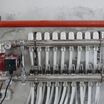
Radiant systems rarely heat a floor evenly. Loops run warmer near the supply, and manifolds, sunny windows and equipment add local heat. Continental Flooring notes that VCT, though more stable than other vinyl, can lift at corners or edges in areas with inconsistent heating.3 It says sheet vinyl exposed to heat above 95°F can develop waves, bubbles or permanent deformation near large windows or heating equipment.3 It names commercial kitchens, mechanical rooms and areas with radiant heating among the places where adhesive softening is a problem.3 Measure surface temperature with an infrared thermometer over the loops and near the manifold during the startup run. Shaw's builder division describes a laser thermometer as an inexpensive, useful tool for checking subfloor and product temperature.12 Fix hot spots before the floor goes down, not after tiles lift over them.
Rolling and bond testing
Good practice for glue-down applies with heat too. EverStep rolls and cross-rolls with a 100 lb sectional roller, then checks and re-rolls after 1-2 hours.4 FloorFolio recommends bond tests: pieces of flooring glued down in several locations with the recommended adhesive and left 72 hours before removal.2 On a radiant floor, put one bond test over the heating loop and run the heat as it will run in service before the main installation. See glue-down adhesive mistakes.
A checklist for glued LVT over radiant heat
- Confirm the flooring and the radiant system are approved for each other.
- Use the adhesive and trowel the flooring guide names for that product.
- Run a new system first; then test moisture.
- Lower the heat before installation as the guide says; hold room temperature during cure.
- Raise the heat gradually; keep the surface under the guide's maximum for good.
Sources
- Mohawk (via Lowe's), “LVT/LVP Residential Limited Warranty”. pdf.lowes.com/warrantyguides/842374006031_warranty.pdf
- FloorFolio, “Installation Guide 2025”. floorfolio.com/wp-content/uploads/2025/FloorFolio-Installation-Guide-202
- Continental Flooring, “How Heat Affects Vinyl Flooring in Commercial Settings”. continentalflooring.com/commercial-vinyl-flooring-heat-damage/
- EverStep Flooring, “LVP Glue Down Installation Guidelines”. everstepflooring.com/technical/lvp-glue-down-installation-instructions/
- Elite Flooring, “Välinge Installation Guide (Woodlands)”. eliteflooringusa.com/links/install-instructions/Elite-Installation-Guide
- Daltile, “ProSeries Luxury Vinyl Flooring Installation & Care Guide (Rigid Core Click, Glue Down)”. s1.img-b.com/build.com/mediabase/specifications/daltile/1996309/daltile-
- EverStep Flooring, “LVP Click Lock Installation Guidelines”. everstepflooring.com/lvp-click-installation-guidelines/
- Armstrong Flooring, “Adhesives FAQs”. armstrongflooring.com/commercial/en-us/resources/flooring-faqs/adhesives
- Timeless Designs, “Click Floating Luxury Vinyl Installation Instructions”. timelessdesignsflooring.com/wp-content/uploads/2023/05/TD-Rigid-Core-Ins
- NFP, “Architect’s Choice LVP Installation Guide”. my-nfp.com/resource/architects-choice-lvp-installation-guide
- INSTALL (International Standard & Training Alliance), “Avoiding Moisture Mistakes in Substrate Preparation - INSTALL Floorcovering Professionals”. installfloors.org/news-events/avoiding-moisture-mistakes-in-substrate-pr
- Shaw Floors, “LVP Case Study: How Temperature Affects Dimension”. shawfloors-sherwinwilliams.com/SiteFiles/sherwinwilliamsdigital/Images/L
General information for the flooring trade. This article was drafted with AI assistance and checked against the sources listed above; the manufacturer's current instructions and the project specification govern any real job. If something here is wrong or out of date, tell us.