 SW-03 · Adhesives & Underlayment
OSHA describes isocyanates as the raw materials that make up all polyurethane products, with exposure occurring in work involving polyurethane foam, surface coatings, under-carpet padding and adhesives.1 The main effects of hazardous exposure are occupational asthma and other lung problems, plus eye, nose, throat and skin irritation.1 OSHA names polyurethane glues and adhesives in building construction among the jobs with increased risk.2
Most flooring crews handle isocyanates without using the word. A urethane wood adhesive, a two-component coating, a foam cushion, a seam sealer: all of these start as isocyanate chemistry, and some of them are still reacting when the pail is open. OSHA treats that class of compound seriously enough to give it its own safety and health topic, and the reasons are worth reading in the original.
What OSHA says they are and where they appear
OSHA defines isocyanates as compounds containing the isocyanate group, which react with compounds containing alcohol groups to produce polyurethane polymers.1 Those polymers are the components of polyurethane foams, thermoplastic elastomers, spandex fibers and polyurethane paints.1 The agency puts it bluntly: isocyanates are the raw materials that make up all polyurethane products.1
The list of jobs that may involve exposure reads like a flooring supply chain. OSHA names painting, foam-blowing and the manufacture of polyurethane products including foam, insulation materials, surface coatings, under-carpet padding, laminated fabrics, polyurethane rubber and adhesives.1 It adds one item crews rarely think about: exposure can occur during the thermal degradation of polyurethane products.1 Grinding, burning or heating an existing urethane layer is not a neutral act.

The health effects, stated plainly
OSHA lists the health effects of isocyanate exposure as irritation of skin and mucous membranes, chest tightness and difficult breathing.1 It notes that isocyanates include compounds classified as potential human carcinogens and known to cause cancer in animals.1 The main effects of hazardous exposures, it says, are occupational asthma and other lung problems, along with irritation of the eyes, nose, throat and skin.1
Occupational asthma is the one that changes a career. OSHA's fact sheet on work-related asthma lists diisocyanates among the exposures with increased risk for allergic or sensitizer-induced occupational asthma.2 The job examples it gives include polyurethane foam insulators, spray painters, spray-on truck bed liner applicators, and polyurethane glues and adhesives in building construction.2 That last entry covers flooring work directly.
The fact sheet's other points matter more than the list. Asthma symptoms may start at work or within several hours of leaving work, and may occur with no clear pattern.2 Work-related asthma can develop over any period of time, from days to years.2 It can occur with changes in work exposures, jobs or processes, such as when a new chemical is introduced.2 It is possible to develop work-related asthma even where a workplace has protective equipment such as ventilation or respirators.2 And it can continue to cause symptoms even when the exposure stops.2
A sensitizer works differently from an irritant. A crew member can handle a product for years without trouble and then react to a small exposure, after which the reaction returns every time. That is why "we have always used this adhesive" is not evidence of safety for the person who has just started coughing.
Cured and uncured are not the same product
The hazard is concentrated in a narrow window. EPA's action plan on MDI explains that completely cured polyurethane products are fully reacted and therefore considered inert and non-toxic.3 Its concern is with unreacted uncured products, which is why it focuses on items used in or around buildings while still curing.3 The Forest Products Laboratory makes the same distinction for wood adhesives, stating that properly cured isocyanate-containing adhesives are not considered hazardous in bonded wood products.4
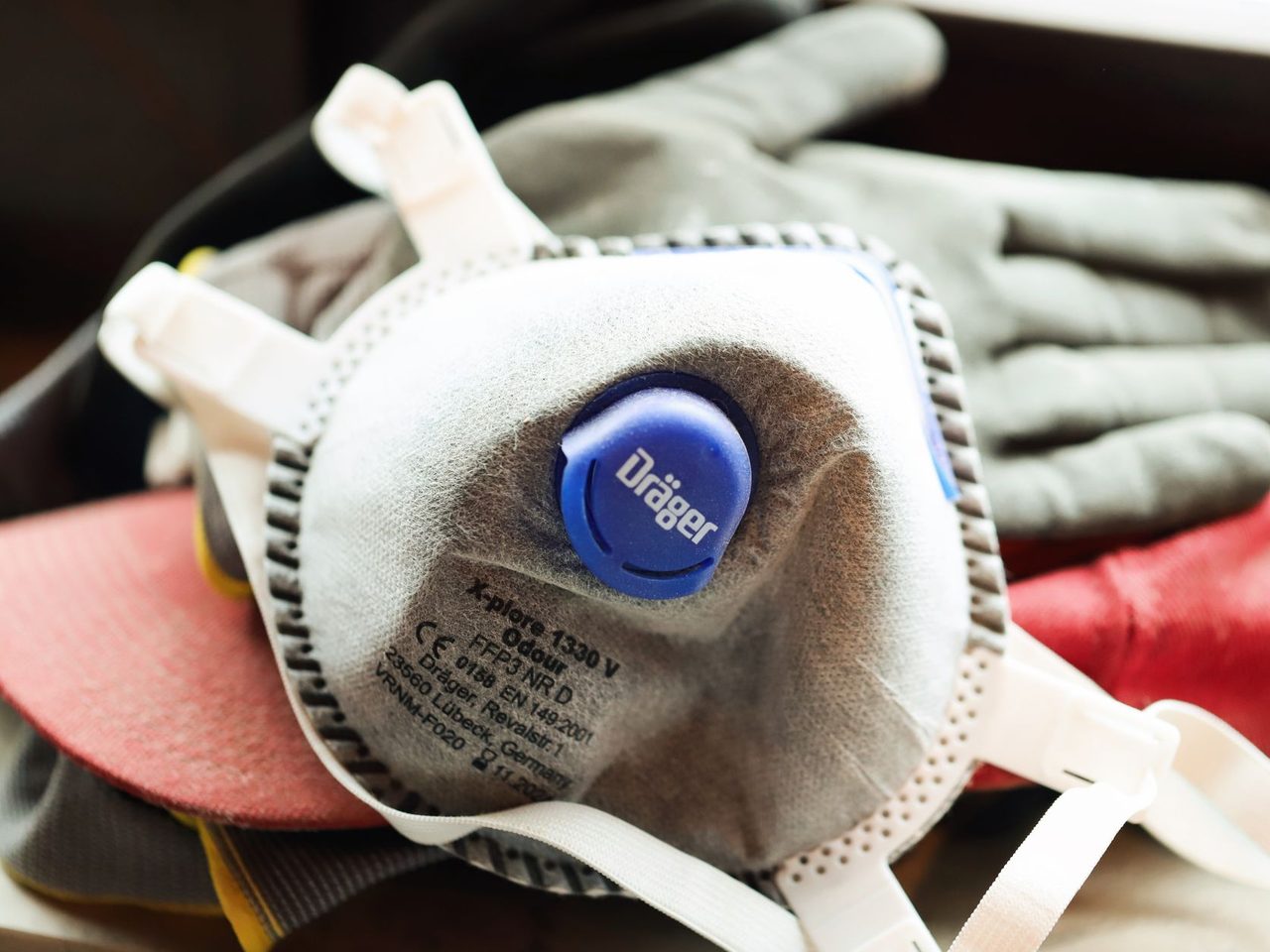
That handbook also gives the practical instruction for the uncured stage. It calls for strict attention to adequate ventilation and the use of personal protective equipment to remove airborne material on dust particles.4 Chronic contact with uncured adhesives containing the reactive isocyanate group should be avoided.4
For a flooring contractor, the division is clean. The finished floor underfoot is not the exposure. Trowelling, spraying, mixing, sanding a partly cured coating and cleaning tools are. See how these adhesives cure.
Where it reaches a flooring job
Three places, mostly.
The first is adhesive. Urethane wood flooring adhesives are spread by trowel over large areas, often in an occupied or partly finished building. Mercier's installation bulletin recommends a urethane-based or silane adhesive to assist nailing on its wider boards, applied by trowel.5 Silane adhesives are a related but distinct chemistry, and some are offered partly because of their handling profile; Bona's silane-based wood floor adhesive publishes a regulatory VOC of 0 g/L as calculated per SCAQMD Rule 1168.6 See silane adhesives.
The second is cushion and backing. ATSDR notes that MDI combines with other chemicals to produce polyurethanes, and that products made with them include carpet padding.7 The Polyurethane Foam Association describes frothed cushion made on carpet backing machinery, where liquid ingredients react in place to form a thin dense foam.8 By the time the roll reaches a jobsite, that reaction is long finished. See cushion types.
The third is demolition and preparation. Because OSHA flags thermal degradation as an exposure route, removing an old urethane-bonded floor with heat, or grinding adhesive residue, deserves the same respect as applying it.1 Dust control and ventilation are the controls, and they are easiest to arrange before the work starts rather than after a complaint.
Reading the label and the data sheet
The safety data sheet is the document that answers the question for a specific product. OSHA's fact sheet advises workers who suspect work-related asthma to report it to their employer, see a healthcare provider, and bring the safety data sheets for the chemicals they use at work.2 It also notes that before working with any hazardous chemical, a worker should ask the employer for the training and information required by OSHA standards such as Hazard Communication.2
A VOC number on the front of a pail is a different measure and does not answer this question. SCAQMD Rule 1168 exists to reduce emissions of volatile organic compounds, toxic air contaminants and stratospheric ozone-depleting compounds from the application of adhesives, adhesive primers, sealants and sealant primers.9 Its limits are set by category: wood flooring adhesive at 100 g/L with a future limit of 20, carpet pad adhesive at 50, and all other indoor floor covering adhesives at 50.9 A low-VOC adhesive can still contain a sensitizer, because the two are measuring different things.
A practical routine
- Keep the safety data sheet for every adhesive, coating and sealer on the job, and make sure the crew can find it.
- Ventilate during application and through the cure, not only while the smell is strong.
- Use gloves that the data sheet names, and change them rather than wiping them.
- Treat sanding or heating a cured urethane layer as its own exposure, with dust control.1
- Take a crew member's new cough or chest tightness seriously, and record when it started and what changed on the job.2
- When a supplier reformulates an adhesive, get the new data sheet rather than assuming the old one still applies.
Why this belongs in a flooring conversation
Flooring crews are not usually the first group named in a chemical safety discussion. Spray foam insulators and auto body painters get more attention, and their exposures are heavier. But OSHA's own list puts polyurethane glues and adhesives in building construction alongside those jobs, and a flooring installer kneeling in a sealed room with an open pail is closer to the hazard than the square footage suggests.2 The controls are not exotic. Ventilation, gloves, a current data sheet and an honest response when someone starts wheezing cover most of it.

What is not the concern
It is worth being as precise about the non-hazard as about the hazard, because overstating it makes crews ignore the parts that matter. A cured floor is not emitting isocyanate. EPA's position is explicit that fully reacted products are considered inert and non-toxic.3 ATSDR adds that MDI is extremely reactive and does not stay in the environment long.7 A customer asking whether their new floor is off-gassing isocyanate is asking about the installation window, not about the floor they will live with.
Sources
- U.S. Occupational Safety and Health Administration, “Isocyanates - Overview | Occupational Safety and Health Administration”. osha.gov/isocyanates
- U.S. Occupational Safety and Health Administration, “Do You Have Work-Related Asthma? A Guide for You and Your Healthcare Provider (OSHA FactSheet)”. osha.gov/sites/default/files/publications/OSHA3707.pdf
- U.S. Environmental Protection Agency, “Methylene Diphenyl Diisocyanate (MDI) and Related Compounds Action Plan”. 19january2021snapshot.epa.gov/sites/static/files/2020-02/documents/mdi.p
- USDA Forest Products Laboratory, “Wood Handbook: Wood as an Engineering Material (FPL-GTR-282)”. research.fs.usda.gov/download/treesearch/62200.pdf
- Mercier Wood Flooring, “Technical Bulletin #9: Fastener selection table”. icms.mercier-wood-flooring.com/icms/webfolder_download/f5da71d27054c1efe
- Bona, “Bona Quantum R851 technical data sheet”. arcat.com/datasheets/bonaus/Bona_Quantum_R851.pdf
- Agency for Toxic Substances and Disease Registry, “ToxFAQs: Toluene Diisocyanate (TDI) and Methylenediphenyl Diisocyanate (MDI)”. atsdr.cdc.gov/toxfaqs/tfacts206.pdf
- Polyurethane Foam Association, “Carpet Cushion Case Study”. pfa.org/carpet-cushion-case-study/
- South Coast Air Quality Management District, “scaqmd-1168”. aqmd.gov/docs/default-source/rule-book/reg-xi/rule-1168.pdf
General information for the flooring trade. This article was drafted with AI assistance and checked against the sources listed above; the manufacturer's current instructions and the project specification govern any real job. If something here is wrong or out of date, tell us.