 SW-01 · Materials & Supply
Pressure-sensitive adhesive holds the tile without curing hard, which is what makes releasable commercial installations possible.1 Peel-and-stick versions carry that adhesive on the tile under a release liner, and the limits are strict: a flat, clean and dry subfloor, no sealed or finished surfaces, and no OSB, luan or particleboard.2 3 Do not add another adhesive, which can cause plasticizer migration and failure.3
Peel-and-stick tile is sold as the beginner's floor: lift the backing paper, press it down, done. The adhesive on the back is a pressure-sensitive adhesive, the same family that commercial installers spread from a pail under carpet tile and LVT. Understanding what that adhesive is, and what it needs, explains both why self-stick floors succeed in some rooms and why they let go in others.
What pressure-sensitive adhesive does
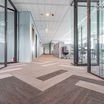
A pressure-sensitive adhesive stays tacky rather than curing to a hard film. Custom Building Products describes its vinyl PSA as suited to most LVP, LVT and carpet tile applications, in permanent or releasable installations.1 That releasable property is the point for commercial carpet tile. CRI 104 describes modular carpet adhesive as a pressure-sensitive type, designed to prevent lateral movement while allowing easy removal and replacement.4 See replacing a carpet tile.
Spread from a pail, PSA has working rules like any adhesive. Custom's data sheet gives a wet-set open time of 60 minutes, and a dry-set working window of 24 hours. Flash time is 15 minutes on porous substrates and 30-45 minutes on non-porous ones.1 Its application temperature range is 50° F to 95° F.1
The moisture limits
PSA tolerates more slab moisture than many adhesives, but it has limits and they are stated. Custom says not to install when moisture vapor emission exceeds 12 lbs. per ASTM F1869, or when relative humidity exceeds 99% per ASTM F2170.1 It sets a concrete pH not to exceed 12, subject to the flooring maker's limits.1 It also states plainly that the product is not a moisture mitigation system.1
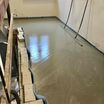
Peel-and-stick products are less forgiving. One self-stick tile instruction says a flat, clean and dry subfloor is essential, because self-stick adhesives will not stick to dirt, dust or high moisture content subfloors.2 It asks for all concrete slabs to be tested for moisture before installation.2 See moisture testing.
Substrates that work, and the long list that does not
A retailer FAQ for peel-and-stick vinyl lists three approved subfloors. They are concrete, exterior and underlayment grade plywood, and properly prepared non-cushion backed vinyl flooring.3 It requires subfloors clean, dry and free of oil, grease, paint, sealers, waxes, curing compounds and excessive moisture. Flatness must be within 1/8-inch over 6-foot and 1/16-inch over 1-foot.3
The exclusions are longer than the approvals. One set of instructions rules out finished or prefinished hardwood, polyurethane or varnished finishes, and any sealed subfloor.2 It also rules out chipboard, OSB, luan plywood, mahogany-based plywood underlayments, Masonite, cement board and fiber-based backing boards.2 The retailer FAQ explains why: those panels are generally not smooth and are made with chemicals that may prevent proper bonding or react with the adhesive.3
Location matters too. The same instructions rule out exterior areas, garages or damp areas, and below grade concrete.2 A product with those limits is a residential and light commercial product, whatever the showroom sample suggests.
Do not add adhesive
The most common field improvisation is the worst one. Asked whether extra adhesive can be used with peel-and-stick tile, the retailer FAQ answers no. Most other flooring adhesives are not compatible, and a secondary adhesive may cause plasticizer migration and adhesive failure.3 If more bond is needed, the answer is a different product, not a second glue.
Primers are a different matter and are often required. The FAQ says to use a multi-purpose primer following its application instructions, with two coats on very porous substrates.3 Custom's PSA lists properly prepared primed or sealed gypsum underlayment among its suitable substrates.1 Use the primer the adhesive maker names, not a paint primer. One instruction sheet is explicit that primers or fillers made for paint or other products must not be used.2
Conditioning and heat
Self-stick products still need acclimation. One instruction sheet asks for 48 hours in the installation environment; a retailer FAQ for another product asks for 8 hours at 60°F-80°F.2 3 Both limit radiant heat: one at floors not maintained above 85°F, the other at a floor not heated above 80°F or cooled below 60°F.2 3 Custom's PSA also lists radiant heated floors with a temperature not exceeding 85° F.1 Read the number for the product in hand.
Peel-and-stick versus a trowelled PSA
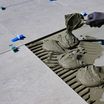
The same adhesive family behaves differently depending on how it reaches the floor. A trowelled or rolled PSA goes down in a controlled film thickness, over a substrate the installer has just prepared and primed. Custom's adhesive is applied by roller or trowel and lists suitable substrates including concrete, terrazzo, plywood, cement-based self-levelers and patching compounds, primed gypsum underlayment and existing well-bonded floor coverings.1 That is a wider list than peel-and-stick allows, because the installer controls the bond line.
With peel-and-stick, the adhesive film is fixed at the factory and the installer controls only the surface it meets. The tile also brings no extra adhesive to fill a slightly rough or porous surface. That is why the acceptable substrate list shortens, the flatness tolerance tightens and dust becomes a failure mode rather than a nuisance. For commercial work, specify a trowelled or rolled adhesive and a product warranted for the space, rather than a self-stick tile.
After installation
New PSA floors need a quiet first week. Instructions ask installers to wait 7 days before wet washing, and to allow 7 days before exposure to water.2 5 They recommend sweeping or vacuuming with a brushless vacuum, and rule out beater bars and rotary brushes.2 They advise against rubber-backed mats, which can discolor the floor.2 See rubber-backed mats and vinyl.
Lifting corners are the classic complaint. The retailer FAQ suggests gently warming the area with a heat gun or hair dryer on a low setting, pressing the tile back and weighting it overnight.3 That works when the cause is a cold or slow bond. It does not work when the cause is a damp slab or a sealed subfloor, which is where most of these floors actually fail.
Sources
- Custom Building Products, “Vinyl PSA Pressure Sensitive Adhesive (TDS-361)”. custombuildingproducts.com/product-pdf
- peel-and-stick tile maker (via Home Depot), “Self-Stick Luxury Vinyl Tile Installation Instructions”. images.thdstatic.com/catalog/pdfImages/ee/ee6adca6-2c73-4166-8df2-9c40a1
- peel-and-stick tile maker (via Lowe's), “Peel and stick luxury vinyl: frequently asked questions”. pdf.lowes.com/productdocuments/10cb29fb-5971-424a-b315-5d011bcfabe7/6278
- Carpet and Rug Institute, “CRI 104 Standard for Installation of Commercial Carpet”. carpet-rug.org/wp-content/uploads/2019/03/CRI-104-STANDARD-For-INSTALLAT
- peel-and-stick tile maker (via Home Depot), “Self-Stick Luxury Vinyl Tile Installation Instructions (12x24)”. images.thdstatic.com/catalog/pdfImages/23/2360563b-538f-463b-9d36-8ee04b
General information for the flooring trade. This article was drafted with AI assistance and checked against the sources listed above; the manufacturer's current instructions and the project specification govern any real job. If something here is wrong or out of date, tell us.