 SW-01 · Materials & Supply
Laminate's wear rating comes from an abrasion test that runs until wear spots appear through the décor layer; ANSI/NALFA LF-01 records the cycle count when wear shows in three quadrants.1 NALFA certification requires 11 tests, not just wear, across four levels from Residential to Heavy Commercial.2 Laminate's core must also meet federal formaldehyde rules, and its warranty depends on dry maintenance.3 4
A laminate floor is a photograph of wood or stone sealed under a thin, hard, transparent wear surface, bonded to a wood-fiber core. The wear surface is where the floor's durability lives. Most buyers meet it as a single rating on a carton or sample board. The rating is useful. It is also easy to over-read, and the standards that sit behind it say much more about what a floor can take.
How the wear test works
Laminate wear resistance is measured by abrading a sample until the decorative layer begins to show through. Intertek, a testing lab, describes the method in ANSI/NALFA LF-01, the North American laminate standard.1 The abrasive paper is first calibrated by wearing a zinc plate; weight loss per 500 cycles must fall within 80 mg to 140 mg.1 The specimen then runs for 200 cycles at a time, with fresh paper each time, until initial wear appears.1 It is then checked every 50 cycles until wear spots at least 0.60 mm2 are visible in three quadrants. The test ends there, and the cycle count is recorded.1 Intertek describes the result as the wear resistance of the flooring.1
In practice, that cycle count is what wear ratings are built on: more cycles before the décor shows, a higher rating.
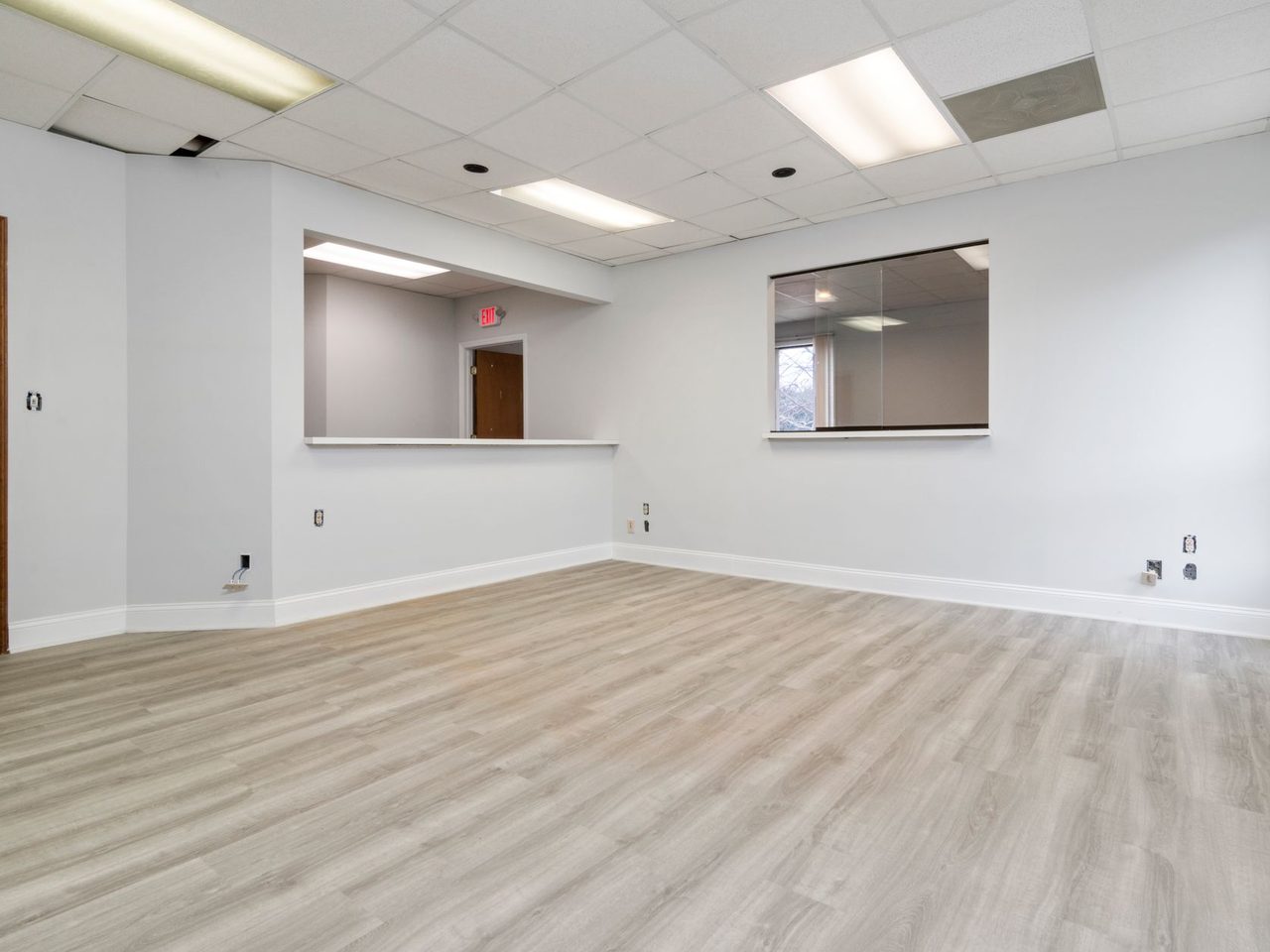
Why one rating is not enough
Dan Natkin, writing for NALFA in Floor Covering Weekly, makes the point directly. It is relatively easy to get a top abrasion rating if a maker ignores texture, dimensional tolerances and other properties.2 For that reason NALFA certification requires a product to pass 11 different test criteria, not one.2 They include:
- Static load: resistance to indentation from objects that stay in one place.2
- Thickness swell: resistance to swelling after exposure to water or moisture.2
- Light resistance, cleanability and stain resistance.2
- Small and large ball impact: resistance to fracturing from dropped objects.2
- Castor chair: the effect of a rolling chair over time.2
- Surface bond: the strength of the bond between décor layer and core.2
For commercial floors, swelling, impact and castor chair results often matter as much as abrasion. A floor that resists wear but swells at the joints when wet-mopped will fail in a corridor long before it wears through.
The certification levels
NALFA certifies laminate at four levels.2 Residential is for active households. Light Commercial covers offices and retail with moderate traffic. Commercial covers hallways, corridors, lobbies and heavy-traffic retail. Heavy Commercial covers airports and heavy commercial use, which may include heavy rolling loads.2 Floor Covering News reported in 2026 that NALFA's board approved revisions to LF-01, moving them into the ANSI process of canvassing and public review.5 It describes the standard as covering resistance to wear, impact, moisture, staining and light, plus dimensional stability.5 Check which edition a product was certified under.
Formaldehyde and the core
Laminate's core is a wood-fiber panel, which brings it under formaldehyde rules. EPA's TSCA Title VI rule sets emission standards for hardwood plywood, medium-density fiberboard and particleboard, and the finished goods that contain them.3 It says that after March 22, 2019, composite wood products must be labeled TSCA Title VI compliant.3 The final rule explains that products marketed as high-density fiberboard are regulated as medium-density fiberboard if they meet that definition.6 NALFA added TSCA Title VI certification to its program in 2018.2
Water: the core's weakness
The wear surface is hard; the core is wood fiber. Mohawk's laminate instructions warn that prolonged water exposure could damage the flooring.4 They exclude products thinner than 8mm from the water warranty, and beveled edge products in bathrooms.4 They forbid wet maintenance, and rule out spray mops, steam cleaners and power cleaners.4 For beveled edge products, they strongly recommend dry cleaning only.4 In commercial spaces cleaned with auto scrubbers, those rules decide whether laminate is a suitable choice at all. See laminate repair.
Underlayment and movement
A laminate floor's performance also depends on what is under it and how it can move. NALFA developed underlayment standards alongside its flooring standard.2 Mohawk's instructions say that where underlayment is pre-mounted on the planks, only a damp-proof moisture barrier should be added beneath.4 They require an expansion joint of 8 to 10 mm on all sides, around pipes and fixed objects and under doors.4 Large rooms need expansion joints every 13 m (40 feet) in each direction, finished with a molding attached to the subfloor.4 A hard-wearing surface does not help a floor that is pinned at its edges and buckles. See expansion gaps for the same principle in vinyl.
Laminate or vinyl for a commercial floor
Laminate and rigid vinyl plank compete for the same spaces, and they wear differently. Laminate's surface resists abrasion very well; vinyl's wear layer is softer but its core does not swell with water. For vinyl, the wear layer thickness drives the warranty; see vinyl wear layers. For laminate, look for the NALFA level that matches the space, the thickness swell result, and the maker's position on wet cleaning. Then compare against the cleaning program the building will actually use, and ask who will clean it.
A laminate checklist
- Ask for the NALFA certification level, not just a wear rating.
- Check thickness swell, impact and castor chair results for the space.
- Confirm TSCA Title VI compliance on the label.
- Match the floor to the cleaning method; avoid wet cleaning where the maker forbids it.
- Read the water warranty's thickness and edge exclusions before specifying for wet areas.
Sources
- Intertek, “ANSI/NALFA LF-01 Section 3.7: Wear Resistance”. intertek.com/building/standards/ansi-nalfa-lf-01-section-3-7/
- Floor Covering Weekly, “Setting The Standards (NALFA LF-01)”. bt.e-ditionsbyfry.com/publication/
- U.S. Environmental Protection Agency, “Formaldehyde Emission Standards for Composite Wood Products”. 19january2025snapshot.epa.gov:443/formaldehyde/formaldehyde-emission-sta
- laminate manufacturer (via Home Depot), “Mohawk Laminate Installation Instructions”. images.homedepot-static.com/catalog/pdfImages/36/36608e02-c5f4-4f65-8f0b
- Floor Covering News, “NALFA advances performance standards”. fcnews.net/2026/05/nalfa-advances-updates-performance-standards/
- Federal Register (EPA), “Formaldehyde Emission Standards for Composite Wood Products (final rule)”. federalregister.gov/documents/2016/12/12/2016-27987/formaldehyde-emissio
General information for the flooring trade. This article was drafted with AI assistance and checked against the sources listed above; the manufacturer's current instructions and the project specification govern any real job. If something here is wrong or out of date, tell us.