 SW-01 · Materials & Supply
NALFA's LF-01 is an ANSI-accredited performance standard that certifies laminate through independent third-party testing.1 A NALFA-authored article lists 11 test criteria, from static load and thickness swell to castor chair and surface bond, across four certification levels from Residential to Heavy Commercial.2 Certification does not replace a manufacturer's own conditions. Mohawk's water warranty, for example, excludes all products thinner than 8mm.3 4
A customer holds up two laminate samples and asks which one is better. The easy answer is the abrasion rating on the box. The laminate certification program was built to get past that answer.
NALFA's LF-01 standard checks a laminate floor across several performance categories, not just one.1 A dealer who knows what each test stands in for can give a more useful answer. That knowledge also shows where the lab result ends and the installation instructions take over.
What LF-01 is, and who keeps it current
LF-01 is the ANSI-accredited performance standard of the North American Laminate Flooring Association.1 It verifies durability and quality through independent third-party testing.1 To be certified, a product must meet minimum thresholds across several performance categories.1 Floor Covering News lists those categories as resistance to wear, impact, moisture, staining and light exposure. The standard also measures dimensional stability and overall product integrity.1
The standard is not frozen. ANSI requirements put LF-01 through a formal review and update process every five years.1 NALFA's board has approved proposed updates. The revised standard now moves on to canvassing and public review.1 The report covers the approval but does not detail the specific changes.1
The program began as a fix for a credibility problem. A December 2018 Floor Covering Weekly article recalls that early laminate carried wild performance claims. Not all of them were verifiable, and each manufacturer tested in its own way.2 A group of domestic manufacturers formed NALFA to set common standards, and it became an ANSI accredited organization.2 The article is written in the association's own voice, so read it as NALFA describing its own program.2
The test battery, one line at a time
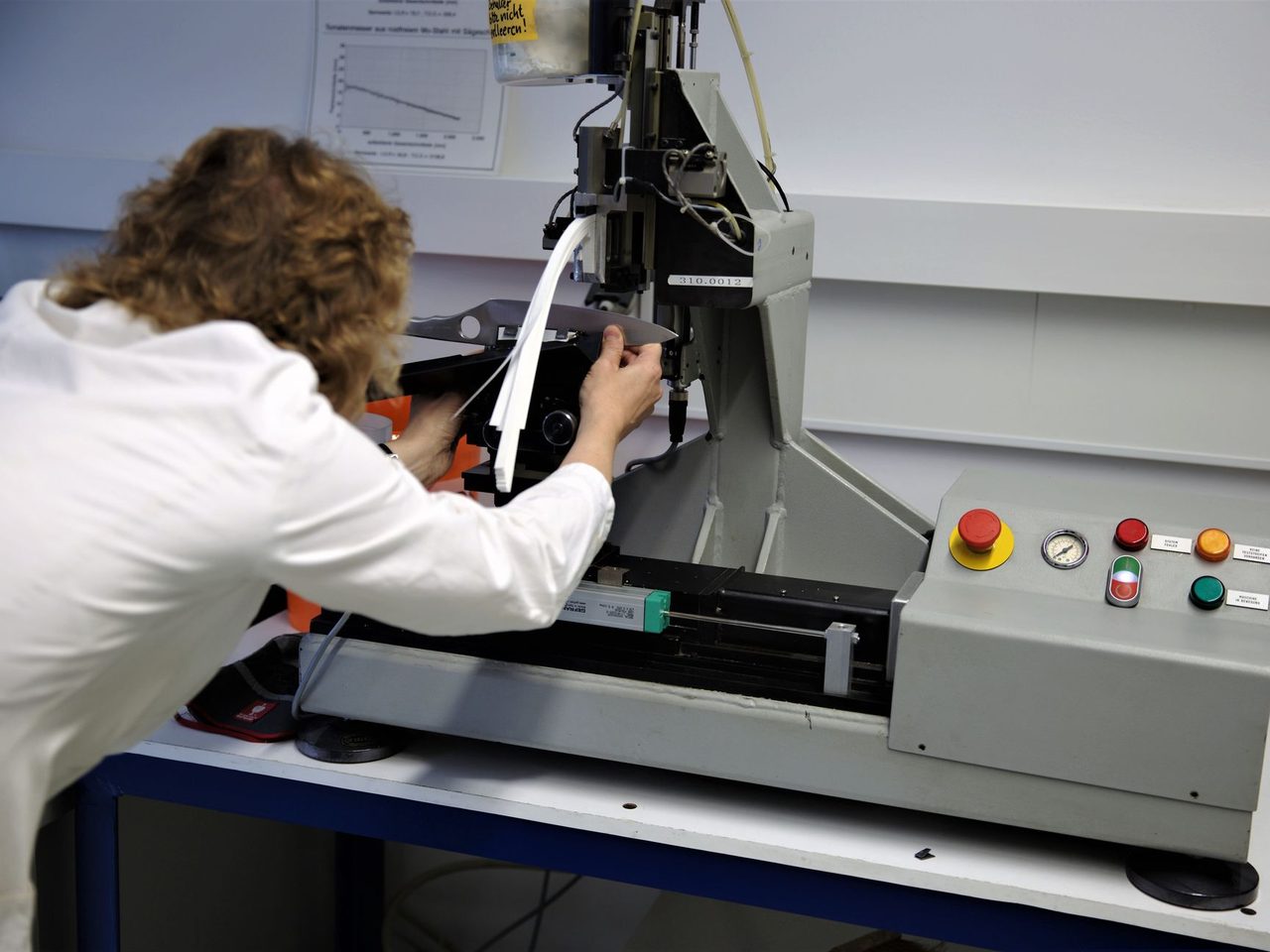
That article says a manufacturer must pass 11 different test criteria to earn NALFA flooring certification.2 Its list puts small and large ball impact under one heading.2 Here is the list, with the association's description of each test.
| Test | What NALFA says it measures |
|---|---|
| Static load2 | Resistance to indentation from something staying in the same place on the floor2 |
| Thickness swell2 | Resistance to swelling after exposure to water or other moisture sources2 |
| Light resistance2 | Ability to keep the original color when exposed to a light source2 |
| Cleanability and stain resistance2 | Ease of cleaning, and resistance to staining from common household substances2 |
| Small and large ball impact2 | Resistance to fracturing from impact by small and large diameter objects2 |
| Wear resistance2 | Resistance of the surface to wear through the décor layer, the "taber test"2 |
| Dimensional tolerances2 | Conformance to stated dimensions, including thickness, squareness and straightness2 |
| Castor chair2 | The effect of a rolling chair over time on the flooring assembly2 |
| Surface bond2 | Strength of the bond between the décor layer and the HDF2 |
| Formaldehyde2 | Compliance with state and federal formaldehyde regulations, including CARB and TSCA Title VI2 |
On a sales floor, the battery turns into plain questions. What will sit on this floor and never move? What will roll across it all day? What will get dropped on it? Two of the tests are invisible to a customer. Surface bond measures how well the décor layer holds to the core.2 NALFA ties dimensional tolerances to factors that improve the installation, such as thickness, squareness and straightness.2 An installer fighting joints that will not close is living with that second test.
Why the abrasion number is not the answer
NALFA's article is blunt about it. It says the easiest way for most manufacturers to cut cost is to focus on one performance attribute and ignore the others, which gives them an "easy sales story."2 Its example is abrasion. It calls an AC5 rating relatively easy to get if a maker ignores texture, dimensional tolerances and the like.2 That is the certifying body's view of its own value, so weigh it as such. The logic still holds. A wear rating on its own says nothing about swell, impact or surface bond.2 For how the wear test itself runs, see laminate wear resistance and the wear test.
Four levels, not one pass mark
The same article lists four levels of certification within LF-01:2
- Residential: suitable for active residential households.2
- Light Commercial: office spaces and retail shops with moderate traffic.2
- Commercial: hallways, corridors, lobbies and heavy traffic retail.2
- Heavy Commercial: airports, and heavy use commercial space that may include heavy rolling loads.2
On commercial work, the level matters more than the logo. A product certified at the Residential level is not certified for a corridor.2 Ask which level applies, and get the answer in writing.
Reading the retail data sheet against the battery
Lay the NALFA list beside a retail data sheet and look for what is missing. A sheet that leads with one number and says nothing about swell or impact leaves those questions open. For how such documents are laid out, see the guide to reading a flooring data sheet. Then check the lab results against the manufacturer's conditions, which is where most money is lost.
Moisture. Thickness swell is a lab measure of resistance to swelling.2 It is not a wet-area warranty. Mohawk's instructions say its water warranty excludes all products thinner than 8mm. They also say it does not apply to beveled edge products used in bathrooms.3 4 Mohawk says its wet-area recommendations should be closely followed to validate its residential water warranty.3 4 All perimeter expansion areas must be completely filled with a water repellent sealant, then left to dry for 24 hours before exposure to water.3 4 That warranty is described as residential.3 4 Pergo says its laminate should not be installed in rooms with floor drains or sump pumps.5 If the sealant step was not in the bid, the installer either absorbs the labor or puts the owner's water coverage at risk.
Rolling loads. Passing the castor chair test does not waive caster rules. Mohawk asks for soft rubber wheels suitable for laminate and/or a suitable protective mat.3 Pergo says chair casters should be rubber, not plastic or metal.5 Facility teams need that in the turnover documents, not just the sales file.
Climate. Dimensional stability is tested in a lab. The building still has to cooperate. Pergo limits its laminate floor to climate controlled indoor installations at 35-65% RH and 60-85° F.5 It says acceptable job site conditions must be maintained throughout the lifetime of the flooring.5 Mohawk tells owners to ensure room humidity is always at least 50%, using a humidifier if needed.3 4 The two makers set different lower humidity limits. Use the one for the product actually going down.
The specific document. Two Mohawk instruction sets sold through the same retailer do not agree. One defines normal conditions as a difference of no more than 25°F and 20% relative humidity between storage and the installed room.3 The other says no more than 60°F and 20%.4 Outside normal conditions, both call for 48 hours of acclimation in unopened packaging.3 4 Read the instructions packed with the product, not a version found online.
What the paperwork does not promise
Certification covers the product, not the sales conversation. The warranty printed with Pergo's wall-installation instructions says catalog, advertising and promotional information is for general informational purposes only and not binding on Pergo.5 It adds that no sales representative or distributor has authority to establish, expand or modify its warranties.5 That text sits in a wall warranty, not a floor warranty.5 It is still worth reading for. If a dealer promises more than the written warranty says, the manufacturer has stated in advance that it is not bound. The exposure stays with whoever made the promise.
Accessories can matter too. Mohawk says accessories other than its own might cause damage to the floor, and that in such a case its coverage will be void.4 Mohawk recommends using only its own accessories.4 When a plank is damaged after installation, repair is a separate problem from certification. See laminate repair for swollen edges and chips.
Formaldehyde, and a standard still moving
The formaldehyde line in the battery checks regulatory compliance.2 It is not a no-emissions claim. Mohawk's instructions carry a Minnesota health notice stating that these building materials emit formaldehyde.3 4 NALFA's article records CARB certification added in 2008, CARB 2 in 2011 and TSCA Title VI in 2018.2 It also mentioned an optional topical moisture resistance test as coming "soon."2 The provided sources do not confirm whether that test was adopted. With the latest revision in public review, a certificate's edition is worth confirming.1
What to ask, check and put in writing
- Ask whether the product is NALFA certified, and at which of the four levels.2
- Match the level to the space. Corridors and lobbies fall under Commercial, and heavy rolling loads under Heavy Commercial.2
- Ask which edition of LF-01 the certification references, since the standard is under revision.1
- For any wet area, read the water warranty's thickness, edge and sealant conditions, and price the sealant in the bid.3 4
- Confirm the caster type the manufacturer requires, and pass it to the facility team.3 5
- Record jobsite humidity and temperature against the manufacturer's stated range before installing.5
- Use the accessories the manufacturer names where its coverage depends on them.4
- Do not promise in conversation what the written warranty does not say.5
Sources
- Floor Covering News, “NALFA advances performance standards”. fcnews.net/2026/05/nalfa-advances-updates-performance-standards/
- Floor Covering Weekly, “Setting The Standards (NALFA LF-01)”. bt.e-ditionsbyfry.com/publication/
- laminate manufacturer (via Home Depot), “Mohawk Laminate Installation Instructions”. images.homedepot-static.com/catalog/pdfImages/36/36608e02-c5f4-4f65-8f0b
- laminate manufacturer (via Home Depot), “Mohawk Laminate Installation Instructions (panels)”. images.thdstatic.com/catalog/pdfImages/38/385535f8-f0f4-4813-a7fa-525441
- laminate manufacturer (via Lowe's), “Pergo MAX Installation Instructions”. pdf.lowes.com/productdocuments/28cb1be7-0f5e-4f01-9cd7-390118a3d475/0274
General information for the flooring trade. This article was drafted with AI assistance and checked against the sources listed above; the manufacturer's current instructions and the project specification govern any real job. If something here is wrong or out of date, tell us.