 SW-01 · Trends
Matte is a measurable number, not a mood: Bona publishes gloss levels of 7-10 for extra matte against 65-70 for gloss.1 Pattern changes cost material and labor, with diagonal layouts needing 15% waste against 10% for standard.2 Rigid core continues to take the entry-level position in composite flooring.3 The documentation demand is the trend that reaches every specification.4
Every January a set of flooring trends appears, and most of it cannot be checked. Warm tones, softer finishes, biophilic textures, smarter materials: the claims are agreeable and unfalsifiable, which is why they survive from one year to the next. That is a problem for anyone who has to buy, specify or install. A trend that turns out to be a showroom preference costs real money when it becomes a stocking decision or a spec.
Some of what gets described as a trend, though, is written down somewhere binding. A data sheet, an installation guide, a code section or a reporting standard. Those are the parts worth paying attention to, and they are the subject here.
Matte is a number
The move toward lower-sheen floors is usually described in feel. It is also a published specification. Bona's commercial waterborne finish is sold in four sheens, and the data sheet gives the gloss level for each.1 They are 7-10 for commercial extra matte, 15-20 for commercial satin, 40-45 for commercial semi-gloss, and 65-70 for commercial gloss.1 That is a measured value, not a description.
Two practical things follow. The first is that a client who says "matte" and an installer who says "matte" can mean different products, and the gloss number settles it before sanding starts. The second is that lower sheen changes what the floor shows. A low-gloss surface hides reflected light and shows soil and scratch patterns differently, which is a maintenance conversation rather than an aesthetic one. The same data sheet notes that stain, sealer and finish results may vary widely depending on the wood species, especially on oily and resinous exotic species.1 It asks for a sample or test area to determine compatibility and appearance.1 On a commercial job, that sample is the only reliable way to agree on what matte means.

Pattern is a cost, and it is documented
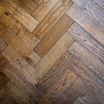
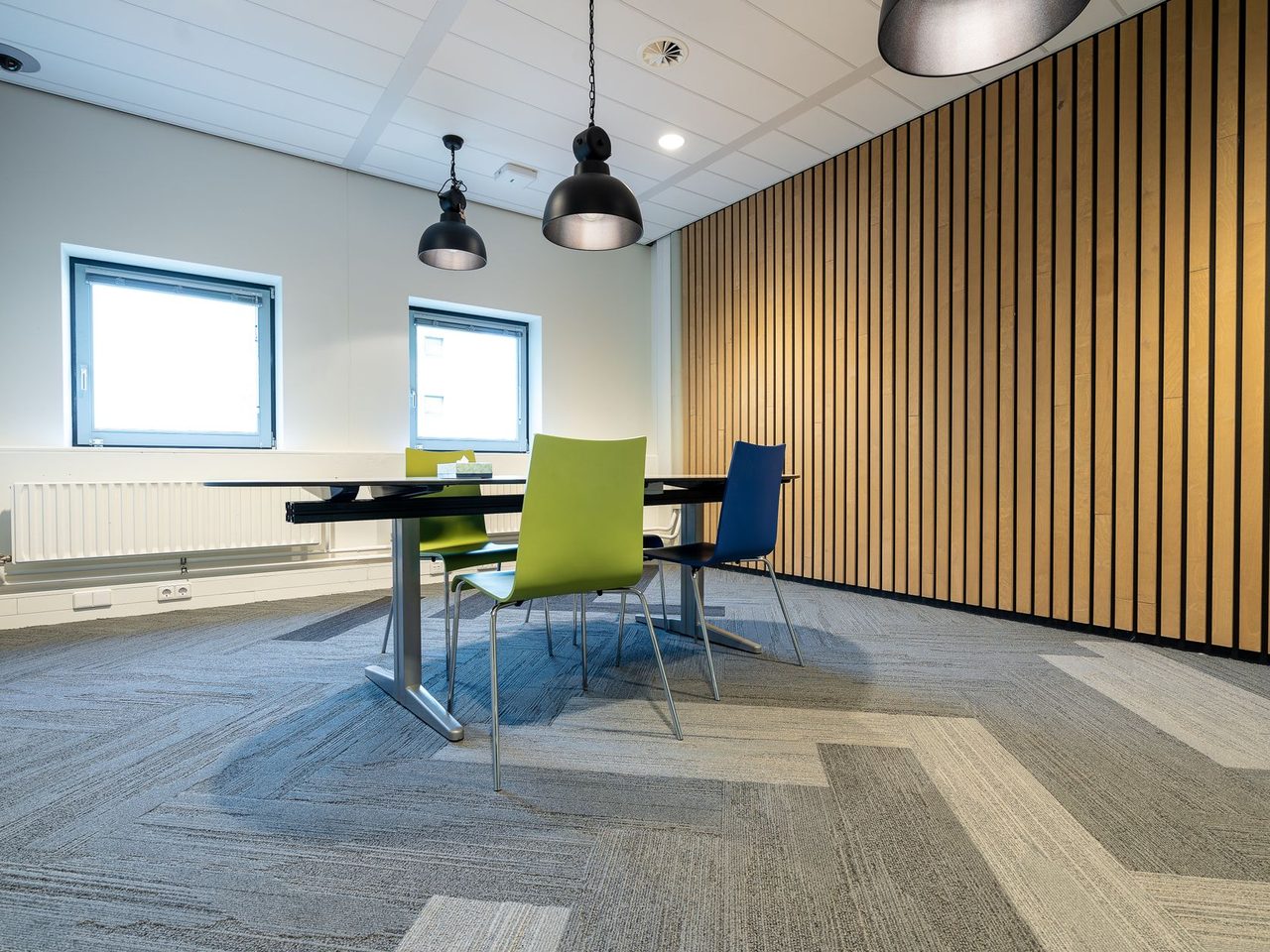
Herringbone, chevron and plank layouts are the most visible change in both residential and commercial flooring. Unlike sheen, they are mostly a labor story. Daltile asks for 10% to be added to the square footage for standard installations and 15% for diagonal layouts.2 That is a real, quotable difference in material before any labor is counted.
Interface's carpet tile guide treats plank and herringbone layouts as a separate discipline. For skinny planks, particularly when laying traditional herringbone, it says measurement accuracy is vital to a successful installation.5 It asks installers deciding on the starting point and pattern direction to consider the longest dimension of the room and the pattern running to the major architectural features.5 A pattern that works on a drawing can fail at a doorway. The guide notes that in some cases, because of doorways or partitions, the starting point is not the center of the room.5
This is the clearest example of a trend with an honest price tag. The look is real and it is being specified. It costs more in material, considerably more in layout time, and it is less forgiving of a substrate that is out of square. See herringbone in click-lock LVP.
Rigid core, and what the category is actually doing
The rigid-core story is often told as a wave that arrived and broke. The trade coverage describes something steadier. Floor Focus traces the disruption to the introduction of WPC, which bridged the laminate and floating LVT categories by offering a rigid, strong, lightweight, easy-to-install floating platform.3 On SPC, it notes that relative density provides higher impact and dent resistance, which generally makes SPC more suitable for commercial environments.3 It adds that SPC floors are less expensive than WPC, and that the market appears to be embracing them as an entry-level product among composite core products.3
The more useful observation in that coverage is about variation. Several manufacturers are experimenting with different constructions, thicknesses, underlayments and surface layers, and some will succeed while others fail.3 A category in that state does not reward brand loyalty at the dealer level. It rewards reading each product's own data.
The composition is not a mystery. Flooret puts its own core at 60 to 70 percent limestone bound with PVC, and credits that density for dent resistance and dimensional stability.6 LX Hausys describes WPC as PVC with less calcium carbonate, plasticizers, a foaming agent and wood-like materials, producing a softer plank.7 See SPC and WPC in the field.

The trend that is actually a code requirement
Acoustic performance is often listed among trends. It is not a trend. In multifamily buildings it is a code minimum, and it has been for a long time. The International Building Code sets a minimum for walls, floors and ceilings separating dwelling units and sleeping units, from each other and from public service areas.8 It is STC 50 for airborne sound by lab test, or NNIC 45 if field tested.8 Floor-ceiling assemblies must also achieve IIC 50 for impact, or 45 in the field.8
What makes this feel like a trend is that hard surface flooring keeps replacing carpet in apartments. That moves impact performance from a problem solved by the floor covering to one that has to be engineered. Commercial Acoustics notes that designing to STC 55 is the standard hedge against the typical field penalty.8 Penetrations for pipes, ducts, outlets and cabinets must be sealed, lined or insulated so they do not degrade the rating.8 A floor is one layer of that assembly. See IIC and STC in apartments.
For a contractor, the practical consequence is that substituting an underlayment is not a trend decision. It is a change to a rated assembly.
Documentation is the real growth area
If one thing has genuinely changed about specifying flooring over the past decade, it is how much paperwork a product has to carry. The Health Product Declaration Collaborative describes its open standard as a rigorous, standard methodology for detailed reporting of product contents and associated health information for building products.4 At the time of its version 2.1 release it reported over 300 manufacturers registered to use the HPD Builder tool.4 Over 2,500 published HPDs were available to the public at no charge in its repository.4
That standard was built to work with green building credits. The 2.1 revision harmonized the format with LEED v4 material ingredients credit requirements.4 It also added a mechanical pre-check indicator for whether LEED-required data elements are present, which does not evaluate content for correctness.4 Environmental product declarations run a parallel track; One Click LCA's review of LEED v4.1 notes that the updates were aimed at making materials credits more accessible for projects.9
Alongside those sits emissions testing. SCS Global Services describes FloorScore as an indoor air quality certification for hard surface flooring materials and adhesives.10 Samples are tested by an approved independent lab to the California 01350 standard.10 See EPDs and HPDs on a flooring submittal.
None of this is glamorous, and none of it appears in a trend roundup. It is, however, the change most likely to decide whether a product can be used on a commercial project at all.
How a trend reaches a jobsite
A look becomes a trend for an installer at the moment it changes a written requirement. That happens in three ways, and all three are visible on paper.
It can change the material count. Daltile's waste allowance moves with the layout, and attic stock is counted separately again; Texas State's standard asks for 5% of each product, or 2% on jobs over 10,000 sf.11 It can change the preparation. The TCNA Handbook tightens substrate tolerances for large format tile to 1/8” in 10’, with no more than 1/16” variation in 24”, and says the project specification must carry a separate requirement to bring a non-compliant substrate into compliance.12 And it can change the submittal, which is where the declarations and emissions certificates land.
None of those are matters of taste. A dealer or contractor who reads a trend through those three filters will usually know, before the first carton is opened, whether the job has been priced for what is actually being asked.
What does not have evidence behind it
Several familiar claims have no source worth citing, and it is more useful to say so than to repeat them.
- Color direction. Warm or cool tone cycles are real in showrooms and genuinely hard to document. Treat them as a merchandising observation about your own market, not a fact.
- "More durable than ever." Durability claims are only meaningful against a test. For resilient flooring, ASTM F3261 sets material, manufacturing, physical and performance requirements for rigid-core modular products.13 A product meeting a standard is a claim you can check; a product being tougher than last year's is not.
- Wider and longer planks. This one is partly documented, because manufacturers publish different installation requirements for wider boards. Mercier recommends assisting the nailing of its wider boards with a urethane-based or silane adhesive to reduce creaking.14 The look may be fashion; the installation requirement is not.
- "Smarter materials." Usually a restatement of the documentation point above. Ask which declaration or certificate is meant.
How to use a trend
For a dealer, a trend is a stocking risk. The question is not whether a look is current. It is how long you will be holding it, and whether the product behind the look sits in a category still changing shape. For a commercial contractor, a trend arrives as a drawing. The useful response is to price the layout and the preparation honestly rather than argue about the look.
For a specifier, the most durable version of a trend is the part that is written into a requirement: a gloss level, a pattern direction, an acoustic rating, a declaration. Those survive the year. The rest is conversation, and it is cheaper to treat it that way.

Sources
- Bona, “Bona Traffic HD technical data sheet”. paneltown.com/wp-content/uploads/2025/03/bona-traffic-hd-tds.pdf
- Daltile, “ProSeries Luxury Vinyl Flooring Installation & Care Guide (Rigid Core Click, Glue Down)”. s1.img-b.com/build.com/mediabase/specifications/daltile/1996309/daltile-
- Floor Daily, “LVT Evolution: What are the key differences between WPC and SPC? - Dec 2017”. floordaily.net/floorfocus/lvt-evolution-what-are-the-key-differences-bet
- HPD Collaborative (via CSRwire), “Health Product Declaration® (HPD) Collaborative Releases HPD Open Standard Version 2.1 – CSRwire”. csrwire.com/press-release/health-product-declaration-hpd-collaborative-r
- Interface, “Carpet Tile Installation Instructions”. interface.com/content/dam/interfaceinc/interface/technical/emea/installa
- Flooret, “SPC vs WPC Flooring: What's the Difference?”. support.flooret.com/spc-vs-wpc
- LX Hausys, “What is SPC flooring? Comparing SPC and WPC”. lxhausys.com/us/blog/wp-json/wp/v2/posts/3110
- Commercial Acoustics, “IBC Section 1206 Sound Transmission Requirements Explained”. commercial-acoustics.com/sound-advice/ibc-1206-sound-transmission-requir
- One Click LCA, “Review of LEED v4.1 EPD credits”. oneclicklca.com/en/resources/articles/leed-v4-1-epd-credits/
- SCS Global Services, “FloorScore® Indoor Air Quality Certification”. scsglobalservices.com/services/floorscore
- Texas State University, “09 65 19 Resilient Tile Flooring and Base design standard”. docs.gato.txst.edu/141401/09_65_19-Resilient-Tile-FlooringBase.pdf
- Tile Council of North America (via CSI Louisville), “tcna-handbook-excerpt”. csilouisville.org/images/downloads/2024_tcna_handbook_shorten_v_ky_.pdf
- ASTM International, “ASTM F3261 Standard Specification for Resilient Flooring in Modular Format with Rigid Polymeric Core”. store.astm.org/f3261-20.html
- Mercier Wood Flooring, “Technical Bulletin #9: Fastener selection table”. icms.mercier-wood-flooring.com/icms/webfolder_download/f5da71d27054c1efe
General information for the flooring trade. This article was drafted with AI assistance and checked against the sources listed above; the manufacturer's current instructions and the project specification govern any real job. If something here is wrong or out of date, tell us.