Two rigid-core planks can look identical under showroom lights, same bevel, same color, same wear layer claim. Then one gets dented by a rolling load, prints every subfloor patch line, or starts clicking loose at the short ends.
The difference is often in the core, and the fastest way to spot risk isn’t a spec sheet. It’s a handful of repeatable field tests you can run at the dock, in the warehouse, or during a pre-install walk.
Below is a practical guide to SPC vs WPC flooring performance, focused on what predicts dents, telegraphing, and joint failure before you commit to a full project.
What changes when you move from WPC to SPC click-lock cores
Rigid-core is a family, not a single product. At a high level, WPC uses a foamed wood-plastic composite style core, while SPC uses a denser stone-plastic composite core (often limestone plus PVC). That core choice drives stiffness, weight, sound, and how the click profile survives real loads.
Here’s the practical way to think about it on the job: WPC behaves more like a hiking boot with a cushy midsole, and SPC behaves more like a work boot with a hard shank. Both can last, but they fail in different ways.
| What you’re trying to predict | WPC core tendency | SPC core tendency |
|---|---|---|
| Point-load dents | More prone to compression dents | Better dent resistance, less “give” |
| Telegraphing on minor waves | Can conform to lows, may show highs | Bridges small lows better, can highlight highs |
| Click-lock stress on uneven subfloors | More forgiving, but joints can “pump” | Less forgiving, higher stress at joints |
| Comfort and sound | Softer underfoot | Firmer underfoot |
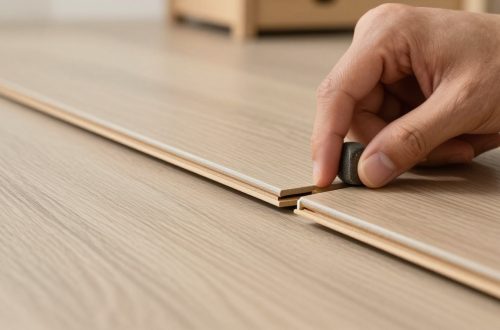
Most crews already know the comfort story. What gets missed is the joint mechanics. A click-lock is a milled shape with a limited amount of “plastic” it can tolerate before the lip crushes, peels, or loses spring. If you want a quick refresher on how profiles differ and why some locks hold better under stress, see this overview of click-lock mechanism comparisons.
Also remember: not all cores are built the same inside flooring manufacturing factories. Formulation, filler loading, foaming rate, and milling quality can swing performance as much as the label on the carton.
The quick dent tests that actually correlate with field complaints
Dents come from point loads (heels, chair legs, appliance feet) and rolling loads (carts, desk chairs, hospitality back-of-house). The goal isn’t to “damage” a sample, it’s to see whether the core crushes, rebounds, or fractures.
A useful baseline is to compare planks from the same visual family (similar thickness and wear layer) and focus on the core’s response.
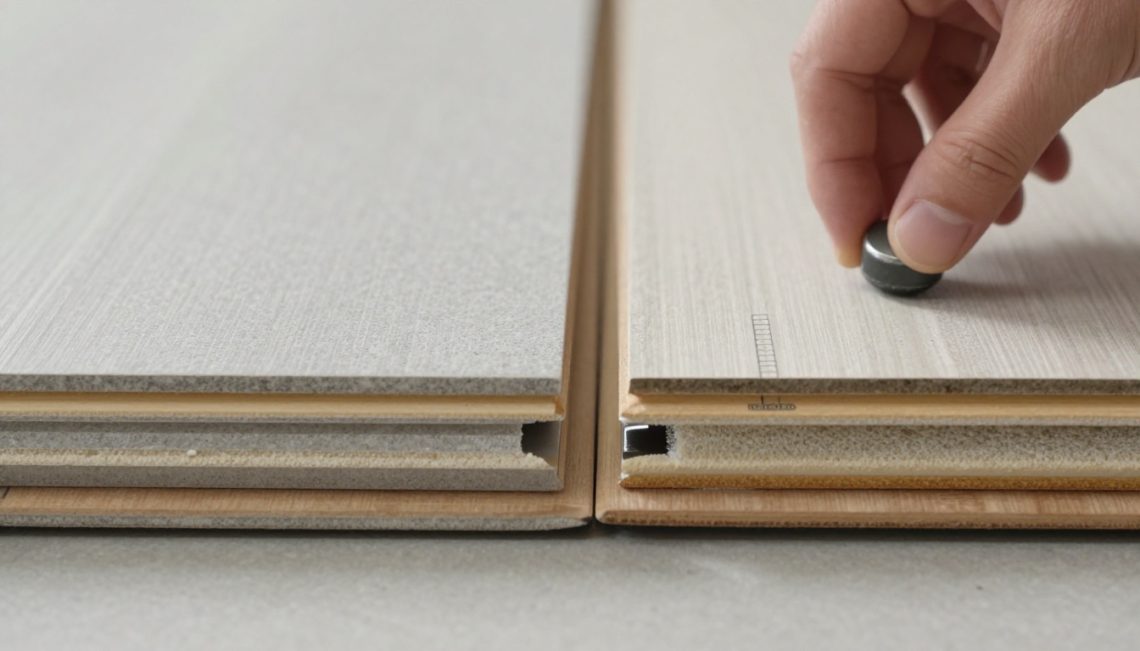
A simple “hard-point” compression check (coin and clamp)
You’re looking for how the plank behaves when a small contact patch hits the core.
- Place a coin near the center of a plank sample (not on the click edge).
- Use a quick-grip clamp, and tighten until you feel real resistance (don’t reef on it).
- Remove the clamp and check the impression with raking light.
What it tells you:
- Visible crater that stays points to a core that compresses under point loads. That tends to show up later as furniture dents, especially with WPC, though some low-density SPC can also do it.
- No mark or a faint mark suggests higher resistance, but keep going. Some hard cores resist dents yet can transmit stress to joints.
The “edge crush” test (predicts chipped lips and broken locks)
Many click failures start as a damaged edge that never seats right again. To check fragility, press your thumbnail firmly into the top corner (wear layer plus edge) near the click. Then tap the corner lightly against a scrap of underlayment or cardboard.
Watch for:
- White stress lines or crumbling at the edge (brittle behavior).
- Mushrooming or flattening (soft behavior that can loosen lock geometry).
If you see either, it’s a warning flag for shipping damage, installer handling, and long-term lock durability.
The “rolling load proxy” (chair caster simulation)
You don’t need a lab wheel. A basic proxy is a hard caster or a narrow furniture leg under a known weight. Even a loaded cart in the showroom can work as long as you repeat it across samples.
You’re trying to answer one question: does the floor surface stay stable, or does it create a track that catches light? The complaint later isn’t “it dented,” it’s “I can see the path across the room.”
If you want a plain-language summary of how core density and construction relate to these behaviors, this primer on SPC vs WPC key differences is a good reference point for teams training new sales and QC staff.

The tests that predict telegraphing and click-lock joint failure
Telegraphing and joint failure share a root cause: movement where the system can’t tolerate it. That movement might come from subfloor waves, deflection, temperature swing, or a lock that isn’t milled cleanly.
The straightedge test (telegraphing risk in 60 seconds)
Rigid core doesn’t “hide” a bad subfloor, it just fails differently than glue-down.
- Lay a 6-foot straightedge on the subfloor.
- Mark the high spots and dips.
- Now set an assembled plank pair across a suspect area and press at each end.
What you’re watching:
- If the plank rocks on a high spot, the lock is about to become the hinge point. That predicts end-joint peaking, cracked corners, and broken lips.
- If the plank bridges a dip but feels springy, you may get a hollow sound and joint pumping under foot traffic.
SPC often bridges small lows better due to stiffness, but it can punish high spots. WPC can settle into lows and still look fine until the locks start working loose.
The twist test (lock strength under shear)
Assemble two planks short-end to short-end. Hold the left plank flat and gently twist the right plank up and down, like you’re wringing a towel, but controlled.
Good signs:
- The joint stays tight, no visible gap, no “crackling” sound.
- The profile shows spring, not crumble.
Bad signs:
- A gap appears and stays.
- You hear crunchy noises.
- The top lip shows whitening or a shaved edge.
This is a fast predictor for joint failure from carts, islands, and heavy foot pivoting.
The temperature sanity check (expansion pressure shows up at the joints)
Rigid-core products still expand and contract. Problems show up when expansion has nowhere to go, and the joint becomes the relief valve.
If you’re evaluating materials for sun rooms, storefront windows, or large open plans, ask for the allowed temperature range and acclimation guidance. Then do a basic spot check: leave samples in a warm area for an hour, assemble them, and see if the ends feel tighter or want to push apart. It’s not a substitute for testing, but it catches products that react fast.
How to use flooring news and annual shows to pressure-test product claims
Field tests help you screen risk, but they don’t replace documentation. The smart play is to combine hands-on checks with what’s happening across the category right now.
In January 2026, flooring industry news is full of materials and compliance conversations, not just visuals. Shaw’s work on a more suitable method for spotting PFAS in non-water manufacturing inputs is a signal that raw material chemistry is under a brighter light, including coatings and additives that can touch resilient surfaces (see Shaw’s PFAS testing methodology news).
At the same time, annual flooring shows keep raising the bar on performance education. If tile and installation best practices impact your mixed-surface projects, scan the session topics in the Coverings 2026 conference education lineup and share relevant sessions with your teams.
Bring these questions to reps when you’re reviewing newest flooring trends and products, and when you’re deciding what becomes your showroom’s newest flooring products:
- What standard is used for indentation and joint strength, and can you share recent results by SKU?
- What underlayment is approved, and what happens to warranty coverage if a different pad is used?
- What’s the flatness tolerance, and is it realistic for remodel work?
- How is click geometry protected during shipping, and what’s the packaging drop test?
You can also track broader flooring trends and product introductions through recurring flooring news features like The Great Reveal 2026, then compare the marketing story to what your field checks reveal.
Conclusion
When you’re deciding on SPC vs WPC flooring, the core isn’t an abstract spec, it’s the piece that decides whether the floor shrugs off dents, hides minor subfloor issues, or starts failing at the joints. A clamp, a straightedge, and a controlled twist test can tell you more in ten minutes than a glossy brochure.
Run the same checks on every incoming line, document what you see, and keep your team aligned between sales and QA. The payoff is fewer claims, fewer callbacks, and more confidence when customers ask what will hold up in their space under real use.
Keep reading
More in Trends: LVP transition strips that don’t pinch a floating floor, gap sizing, fastener placement, and common failure signs, 2026 Carpet Shortages And Nylon Allocation What Dealers Should Watch, 2026 Flooring EPD and HPD Requirements for Specs.