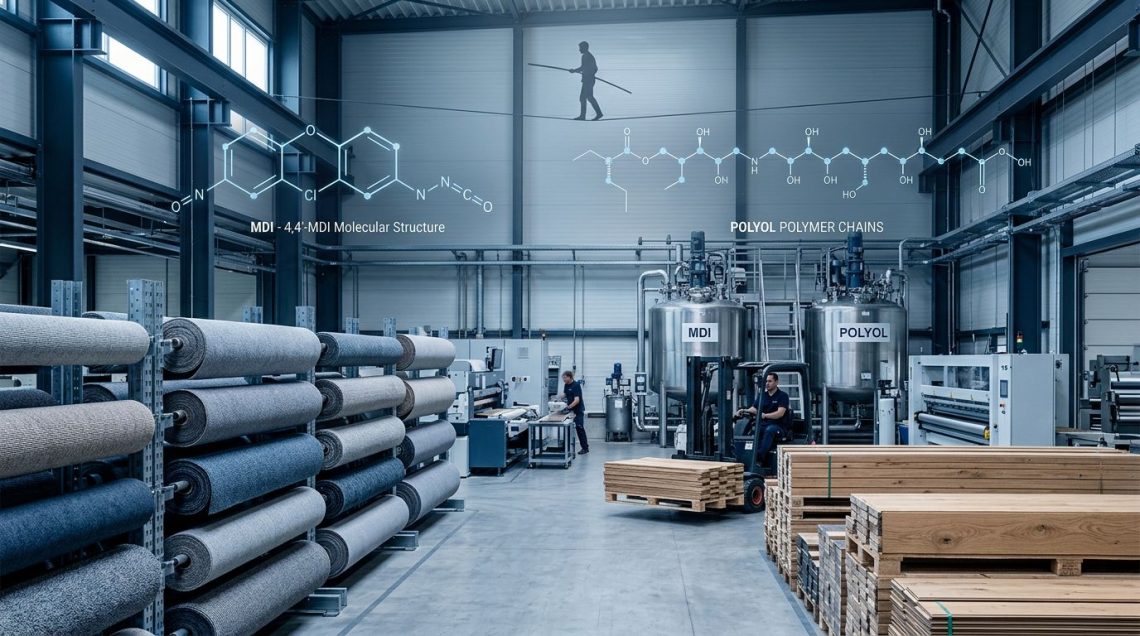
If your products rely on polyurethane, 2026 probably feels like walking a tightrope. One side is performance demands from customers, on the other is raw material volatility, especially for MDI (Methylene Diphenyl Diisocyanate), that can swing margins fast.
This MDI polyurethane outlook focuses on what flooring manufacturers and retailers should watch in 2026: understanding the polyurethane market size, which is critical for navigating raw material volatility, along with MDI and polyol supply signals, where polyurethane specs are heading, and how to reduce risk inside plants and purchasing teams. It also connects the dots to the newest flooring trends and products you’ll see discussed across flooring industry news as the year unfolds.

What’s driving MDI and polyol supply and pricing in 2026
MDI (Methylene Diphenyl Diisocyanate) and polyols sit at the center of many flooring chemistries: carpet backing and cushion, wood floor finishes, resilient adhesives, moisture barriers, and acoustic underlayments. Toluene Diisocyanate also influences the broader isocyanates market. In 2026, demand stays tied to construction and repair cycles, but supply behavior matters just as much as demand.
Capacity remains global, and it’s not evenly distributed. Asia Pacific continues to hold a major share of production, which means North American buyers still feel the ripple effect of overseas plant outages, changes in operating rates and the phosgenation process, freight changes, and regional demand surges in Asia Pacific. Even when your order book looks stable, upstream events can land in your cost model with little warning.
Recent market commentary still frames MDI and polyol pricing as “moveable,” especially when energy and feedstock costs shift. For a practical look at market dynamics and why raw material prices can turn quickly, see the industry view from MDI, TDI, and polyol pricing commentary.
In real operations, the 2026 playbook looks less like chasing spot deals and more like building reliability:
- Longer-term supply agreements help when allocations appear, especially for consistent grades.
- Dual sourcing reduces the risk of one plant issue stopping a whole line.
- Supply chain analysis identifies vulnerabilities in North America and Asia Pacific.
- Specification discipline matters, because “almost equivalent” MDI or polyol can change cure, color, or odor.
- Inventory rules by SKU beat broad “weeks on hand” targets, since not every input has the same substitution options.
When MDI tightens (with Toluene Diisocyanate availability sometimes serving as a leading indicator for MDI trends), it’s rarely dramatic at first. It shows up as longer lead times, narrower grade options, and more conditions attached to deliveries.
Performance and compliance are reshaping polyurethane specs in flooring
In 2026, polyurethane choices aren’t only about cost per pound. They’re increasingly about what your floor has to survive, and what your customer refuses to smell.
On the product side, the pull is clear: fewer callbacks, better wear, and easier cleaning. That demand shows up in polyurethane finishes, coatings and elastomers for wood and resilient, plus adhesives and sealants that can handle temperature swings and serve as critical moisture barriers. At the same time, retailers keep asking for clearer stories around indoor air quality and emissions. This is why waterborne polyurethane coatings and lower-VOC systems keep gaining attention, especially for factory-applied finishes that reduce variability on-site.
Sustainability is also changing the conversation, but it’s becoming more specific. Buyers want recycled content claims, bio-based polyurethanes, and other sustainable materials that stand up to audits, and they want documentation that aligns with customer requirements. As of March 2026, market research continues to forecast growth for Methylene Diphenyl Diisocyanate (MDI)-related categories over the next several years, driven largely by energy efficiency in buildings and construction demand, particularly for insulation materials like rigid polyurethane foam. One example is this MDI market outlook summary, which frames energy-efficient building drivers as a key tailwind.
Compliance concerns are widening too. PFAS attention, amid tightening environmental regulations, is a good example of how scrutiny spreads from finished goods into inputs and processing aids. In late 2025, Shaw Industries shared it developed a new approach to detect PFAS in manufacturing materials, because common protocols did not fit many non-drinking-water inputs. That’s covered in Shaw’s PFAS testing methodology news. For flooring producers, the takeaway is simple: raw material testing and supplier declarations are becoming part of product strategy, not just a quality task.
All of this flows straight into flooring trends. Retailers want floors that look natural, resist scratches, and install faster. Meanwhile, manufacturers need chemistries that keep up with line speed and field conditions, especially when launching the newest flooring products that claim “waterproof” or “kid-proof” performance through technological advancements.
A practical 2026 risk plan for flooring manufacturing factories and buyers
The fastest way to feel “surprised” by polyurethane inputs is to treat them as commodities. Methylene Diphenyl Diisocyanate and Toluene Diisocyanate, used across various sectors including the construction sector and the automotive industry, can change foam density, coating hardness, open time, and yellowing with small shifts in type, polyol functionality, catalysts, or additives. That’s why the best 2026 risk plans blend procurement, formulation control, and shop-floor testing.
Use this table as a simple starting point for cross-team alignment inside flooring manufacturing factories:
| Risk area | What it looks like in 2026 | Most useful response |
|---|---|---|
| Supply allocation | Lead times stretch, preferred grades of flexible polyurethane foam and rigid polyurethane foam disappear | Qualify alternates early, lock critical SKUs |
| Cost volatility | Sudden increases tied to feedstocks and energy | Contract structure with triggers, disciplined surcharges |
| Regulatory pressure | More questions about emissions, restricted chemistries, and end-use industry requirements | Documented declarations, targeted testing, supplier audits |
| Performance drift | “Equivalent” substitutions cause failures | Tight specs, incoming QC, pilot runs before full changeovers |
The other half of risk planning is staying close to the market. Annual flooring shows still matter because they compress months of conversations into a few days. They also highlight where polyurethane requirements are heading, from adhesive claims to finish durability, including technological advancements in thermal insulation properties crossing over from insulation materials into flooring underlayments. For example, Coverings 2026 conference education signals what specifiers and contractors are focused on, including installation quality and system thinking that often affects underlayments, membranes, and adhesives. Demand recovery in the construction sector and automotive industry affects end-use industry pricing for flooring.
Training ties in as well. Installation issues can turn into “material problems” in the customer’s mind, especially as electric vehicles and other high-tech applications in the end-use industry drive similar quality standards in the construction sector. The National Tile Contractors Association has promoted new training opportunities for early 2026, outlined in NTCA January 2026 training coverage. Better installation reduces warranty friction, which helps the whole channel.
Finally, keep your team plugged into flooring news and regular supplier updates, including developments around Toluene Diisocyanate. The companies that win in 2026 will connect product development to what buyers see on the floor, including the newest flooring trends and products shown at events and discussed across flooring industry news.

Conclusion
The 2026 MDI polyurethane outlook for flooring is shaped by Methylene Diphenyl Diisocyanate dynamics in the global market, mixing steady demand and unpredictable inputs. This projection aligns with a compound annual growth rate that will expand the polyurethane market size through 2030 at a projected compound annual growth rate. Winning teams leveraging these strategic insights will tighten specs, qualify alternates before they’re needed, and treat compliance and testing as part of product planning, particularly for innovations in sustainable materials, rigid polyurethane foam, adhesives and sealants, and coatings and elastomers. Keep one eye on raw material signals, and the other on what customers expect from modern floors. What performance claim will your next launch have to prove in the field?