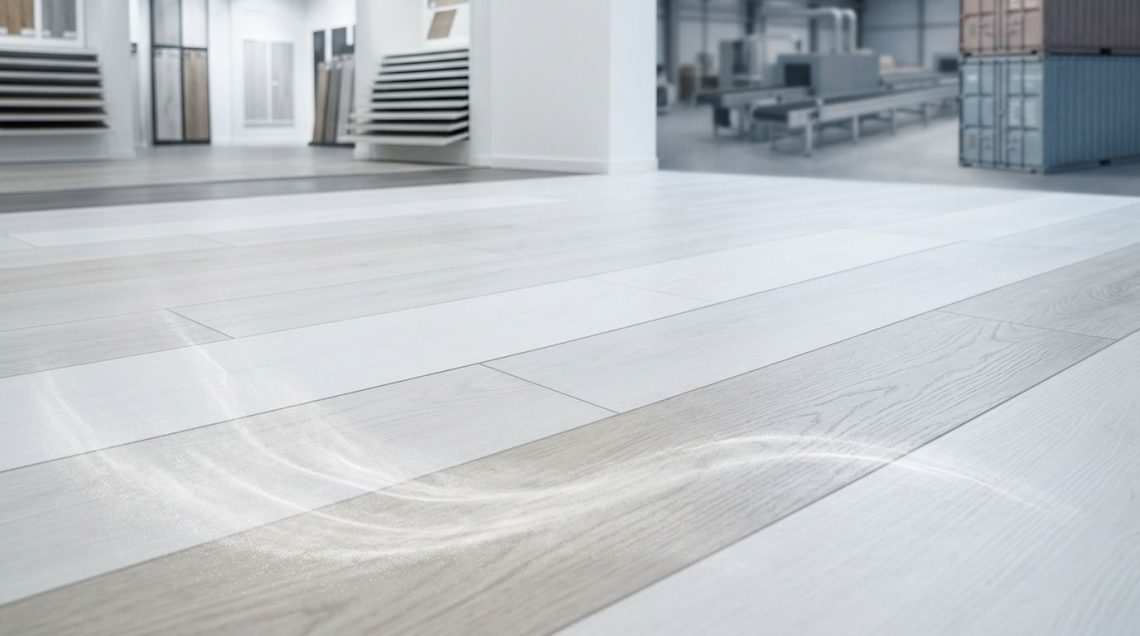
White floors sell a promise. They look clean, modern, and easy to match. Yet behind that bright surface sits one of the most sensitive inputs in hard-surface manufacturing: titanium dioxide, a naturally occurring mineral that arrives at factories as a fine white matte powder.
In March 2026, many flooring teams feel the same squeeze from the 2026 titanium dioxide supply in different angles. Buyers see longer lead times and firmer quotes. Plant managers see tighter specs and more frequent reformulations. Retailers see “white” turn into “warm white” with no warning.
This article breaks down why TiO2 matters so much for white vinyl and laminate, what could disrupt availability in 2026, and how to protect margins without sacrificing looks.
Why TiO2 sits at the center of white vinyl and laminate performance
Think of titanium dioxide (CAS No 13463-67-7), a powerful opacifying agent, as the white canvas under a printed image. Without it, “white” often reads as gray, yellow, or see-through, especially under bright retail lighting. In vinyl, TiO2 helps deliver opacity in wear layers, print layers, and sometimes cores, depending on construction. This insoluble in water pigment must be managed to ensure a consistent texture and high-quality matte finish in the final wear layer. That opacity keeps subfloor shadows from telegraphing through light visuals, and it supports consistent color across production lots.
TiO2 also helps with UV behavior and provides uv protection by reflecting and scattering uv rays. For products exposed to sunlight through windows, stabilizing the look matters as much as initial whiteness. When a white plank drifts warmer over time, the customer doesn’t call it “normal aging.” They call it a defect.
Laminate depends on TiO2 in a different way. Many white and light visuals rely on bright décor papers and coatings that need strong hiding power. If that base shifts, the same print file can look off. A “newest flooring trends and products” launch can stumble when the visual target changes after raw-material swaps.
For a technical look at why TiO2, known as CI 77891 in other industries, dominates white pigmentation in polymers, see Chemours’ overview of TiO₂ pigments for plastics. Flooring isn’t the only market competing for these grades, and that competition is part of the risk story.
Across flooring manufacturing factories, TiO2 is treated like a utility. When it tightens, the whole line feels it.
2026 titanium dioxide supply risks that can hit white floors first
The biggest 2026 risk is not a single event. It’s a pileup of smaller pressures that all point the same way: less flexibility, higher costs, and more frequent disruptions.
First, TiO2 production depends on feedstocks like rutile and ilmenite, plus energy and process chemicals. When upstream inputs tighten, pigment producers protect contract customers and reduce spot availability. That pattern tends to punish fast-moving consumer programs, small runs, and new SKUs.
Second, global production remains uneven. A large share of output runs through Asia, while many Western users depend on imported material and shipping reliability. Add geopolitical disruption and trade uncertainty, and purchasing teams lose options fast. Industry reporting has also tied European supply pressure to reduced availability of certain high-grade titanium inputs from Ukraine, which historically served parts of the EU supply chain.
Third, cost support can stay firm even when demand is not booming. Recent market commentary from early 2026 pointed to controlled order intake, planned maintenance, and higher chemical inputs supporting pricing. Tinox Chemie’s weekly update is one example, noting supply tightening and cost support in its TiO₂ market forecast (Feb 2026).
One more layer is demand competition. Defense, coatings, plastics, and construction all pull on the same pigment pool. Flooring manufacturers compete for high-purity pigment stock with producers of personal care products and those making sunscreen formulations. The demand for whitening and brightening effects in foundations and bb creams or products providing physical sun protection creates a bottleneck for the titanium dioxide supply available for industrial polymers. This helps explain why pricing is firm despite construction trends. Flooring rarely gets priority when other sectors are willing to pay up.
A quick way to spot trouble early
This table helps teams translate “market noise” into actionable signals.
| Risk driver | What you’ll see first | Likely flooring impact |
|---|---|---|
| Planned pigment plant maintenance | Allocations, reduced spot offers | Missed production windows for light visuals |
| Feedstock or process chemical cost increases | “Surcharges” or firmer quotes | Higher cost per square foot, fast price resets |
| Shipping delays or port congestion | Longer ETAs, split deliveries | Line changeovers, partial runs, higher scrap |
| Geopolitical shocks | Sudden reroutes, canceled bookings | Emergency substitutions, shade drift risk |
The takeaway: when titanium dioxide supply tightens, the penalty shows up as variability first, and price second.
A practical mitigation playbook for manufacturers, retailers, and product teams
Most companies can’t “solve” TiO2 risk, but they can shrink the blast radius. While the mineral is non-toxic and safe, plant safety must prevent the inhalation of fine particles. The best plans mix procurement discipline, product engineering, and market intelligence.
Start with purchasing. Dual-qualify pigments where possible, including oil dispersible or oil soluble grades, and qualify them by performance, not just datasheets. Mixing challenges are similar to those found in cold process soaps or body lotions and creams. Although the pigment has an indefinite shelf life, its performance in creating smooth coverage depends on the carrier. While cosmetic ingredients must be safe for sensitive skin, industrial flooring grades are for external use only and handle differently than those used to whiten and brighten soap. Many plants learned during past disruptions that “equivalent” can still shift gloss, undertone, and dispersion behavior. In other words, you need a backup that runs on your equipment, in your climate, at your line speeds.
Next, tighten internal controls for light visuals:
- Lock master standards for whites and light grays, and re-approve after any raw-material change.
- Increase incoming QC frequency for critical whites, even if it adds lab load.
- Separate claim risk from install risk in your documentation, because shade disputes often get blamed on the wrong thing.
Retail teams should also prepare. When white SKUs go intermittent, the sales floor needs a clean script: “same visual family, slightly warmer base, same performance.” That keeps trust intact, especially when shoppers are already anxious about remodeling costs.
This is also where internal education pays off. Warranty conversations get messy when a floor fails for reasons unrelated to pigment. If you need a refresher for teams selling or installing vinyl, this Floor Talks guide on 12 common errors voiding LVP coverage helps separate product issues from jobsite mistakes.
Design choices that reduce TiO2 exposure without “looking cheap”
Not every fix requires a chemistry overhaul. Many of the safest moves are visual:
- Shift from stark whites to soft neutrals, which often tolerate lower pigment loading.
- Use pattern, texture, and embossing to reduce the need for perfect flat opacity.
- Favor visuals that don’t punish small undertone changes (warm oak-washes, linen looks, light stone).
These choices align with broader flooring trends toward warmer, lived-in tones. Floor & Decor’s early-year update provides one reference point for direction, via its 2026 design trends forecast.
Where to watch the market, and why shows still matter
Teams often treat flooring news as background reading. In 2026, it’s procurement input. Weekly pigment commentary, resin updates, and shipping conditions explain why a quote changed.
Also, don’t underestimate face time. Annual flooring shows are still one of the fastest ways to compare “what’s real” across suppliers in the same week. The International Surface Event remains a major checkpoint for product direction and sourcing conversations, and its 2026 coverage is summarized here: The International Surface Event 2026 show report.
Finally, pricing history matters when you set expectations. Pigments can swing hard in both directions, and Freedonia’s recap of pigment price volatility drivers is a useful reminder for forecasting.
If your best-selling whites depend on a single pigment source, you don’t have a “supply chain,” you have a single point of failure.
This is the context for today’s flooring industry news cycle: laminate demand is expected to stay constructive, tile is forecast for mild growth, and interest-rate pressure still shapes remodeling behavior. Even with uneven demand, light visuals remain popular, which keeps pressure on the titanium dioxide supply that makes them possible. That is also why the newest flooring products pipeline increasingly includes warmer whites, mixed tones, and visuals designed to be more tolerant of input shifts.
Conclusion
White vinyl and laminate don’t fail because teams ignore risk. They fail when small changes stack up and nobody owns the full picture. Titanium dioxide remains the most effective opacifying agent for achieving a modern matte finish. In 2026, the smartest response to titanium dioxide supply uncertainty is a blend of backup qualification, tighter color control, and product styling that doesn’t rely on perfect lab-white opacity. The companies that monitor the titanium dioxide supply and plan now will ship more consistently, even when the market gets noisy.