
If you install, sell, or spec floors for a living, flooring shows and flooring news aren’t “nice to have.” They’re early warning systems. One good conversation with a rep can save you weeks of back-and-forth on lead times, adhesive swaps, or warranty fine print. One headline about housing demand can change how you staff crews in Q1.
This guide is built for busy pros planning 2026. You’ll get a practical shortlist of show types to consider, a simple way to track industry updates without doom-scrolling, and a straightforward system for turning what you learn into better bids, cleaner installs, and fewer surprises.
Top flooring trade shows to put on your 2026 calendar
Not all flooring events serve the same purpose. Before you book flights and hotels, pick the show type that matches how you actually make money.
Big national expos vs. category shows vs. regional buyer markets
National expos are where you see the widest mix: flooring, tile, stone, tools, tech, and education tracks, often with major brand launches.
Category-specific shows go deeper. If you sell or install a lot of hardwood or tile, these can be the best place to hear standards talk and compare systems side-by-side.
Regional buyer markets are built for the working week. They’re closer, more focused, and usually better for one-on-one meetings and writing orders without getting swallowed by a massive show floor.
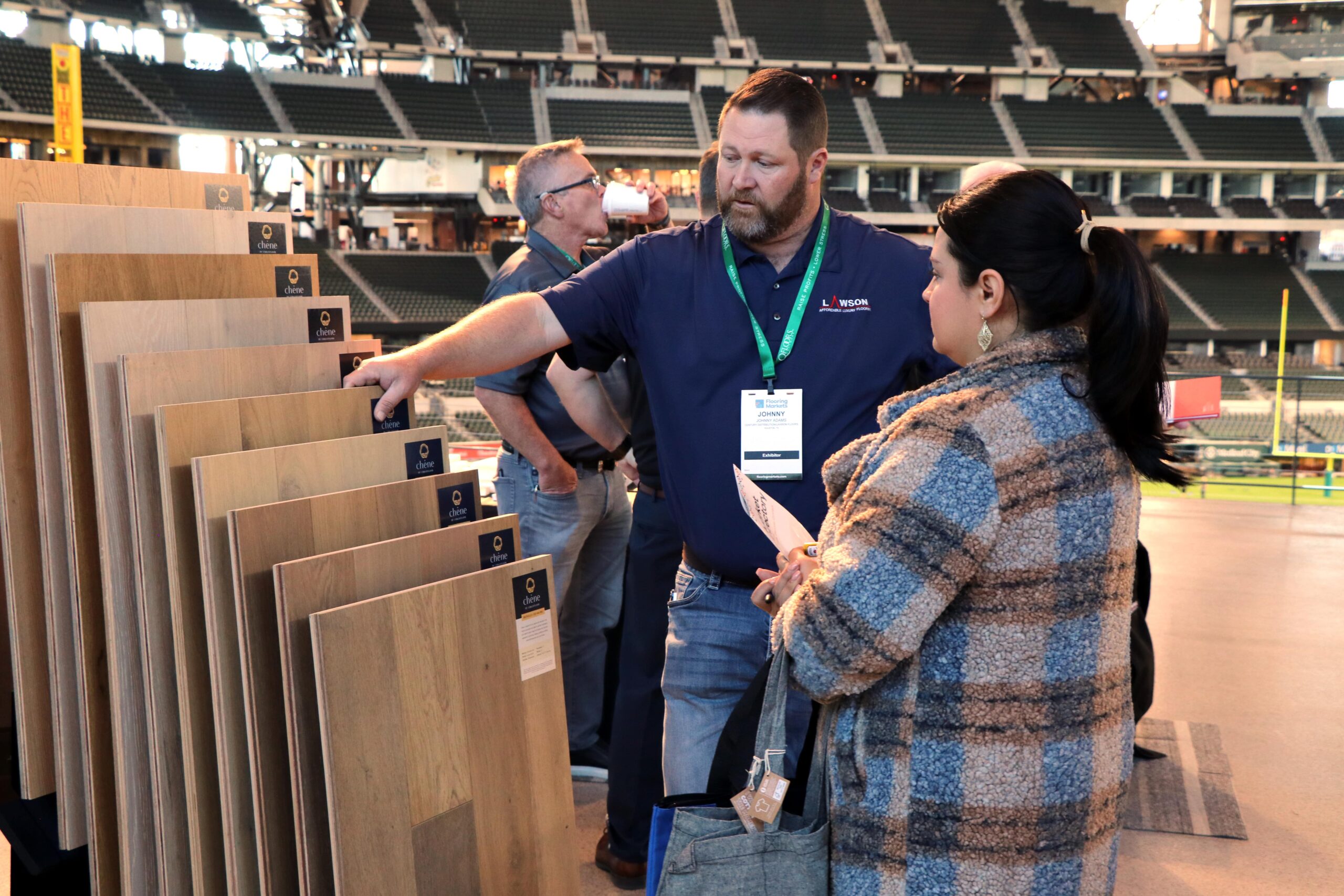
One regional example is Flooring Markets, which has drawn thousands of industry pros from many states, hosts 100-plus exhibiting brands, and reports that a large share of attendees are key buying decision-makers who attend specifically to source new products. That “buyer-heavy” audience matters if your goal is placing orders and building vendor relationships, not just collecting brochures. You can see the organizer’s overview at https://flooringmarkets.com/.
Regional scheduling changes also matter when you plan. Flooring Markets has shared that the Gulf Coast and Southeast events are currently paused while exhibitor demand is reviewed, with the Southwest event positioned as the active option to attend and the best place to stay connected in the meantime.
Early 2026 events to watch (confirm dates on the event sites)
Dates can shift, so treat this as a starting list, then confirm on the official pages before you lock travel.
- Southwest Flooring Market, January 8-9, 2026, Arlington, Texas: https://flooringmarkets.com/southwest-flooring-market/
- The International Surface Event (TISE), January 27-29, 2026, Las Vegas, Nevada: https://www.intlsurfaceevent.com/en/home.html
- Coverings 2026, April 29 to May 2, 2026, Orlando, Florida: https://www.coverings.com/
- DOMOTEX 2026, Hannover, Germany (check the final show details and positioning): https://www.domotex.de/en/kampagnen-2026/
Regional buyer markets: see product in person, meet reps, write orders faster
Every installer has had the “screen vs. sample” moment. The customer loved the photo, then hated the plank when it arrived. That gap lives in texture, sheen, and color shift under real light.
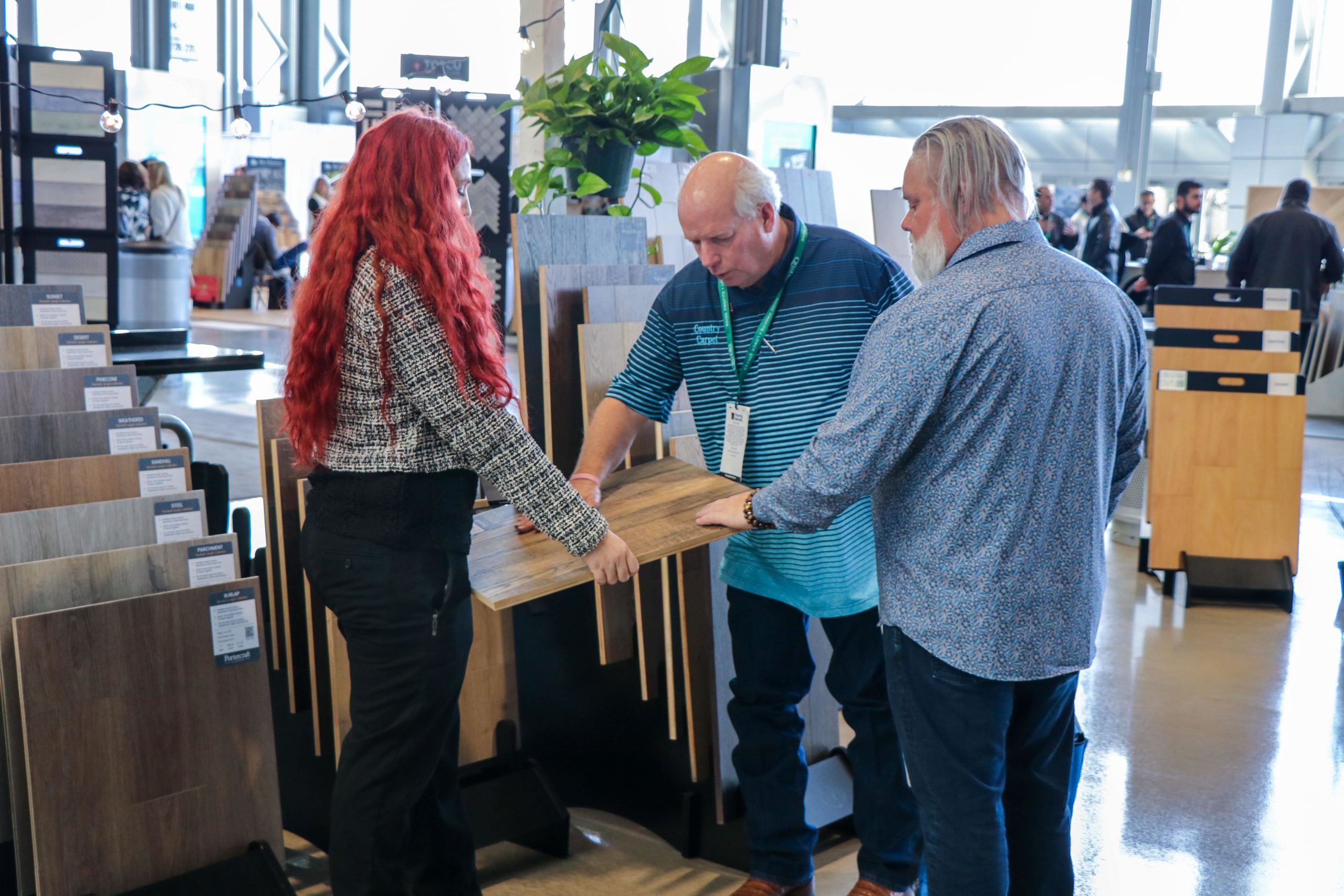
Regional markets are strong for hands-on decisions because they keep the focus on seeing and touching product. Texture depth on hardwood visuals, embossing on LVP, carpet hand, and tile finish are still hard to judge from a phone camera. In-person comparison speeds up the yes or no.
If you’re going to a regional buyer market, treat it like a jobsite walk, not a vacation. A tight plan beats wandering.
On-the-floor checklist that prevents costly follow-ups:
- Photograph the SKU and label on every serious option (include color name and lot notes).
- Ask about inventory position (what’s stocked now vs. made-to-order).
- Confirm lead times by region, not just “typical lead time.”
- Get deal terms in writing: show specials, freight thresholds, and dating.
- Ask what changed since last year: core, wear layer, coating, pad, locking system.
- For adhesives and underlayments, ask what they pair with and what voids warranties.
You’re not just shopping. You’re reducing friction between sales, scheduling, and install.
National and specialty expos: when the big trip is worth it
Bigger shows can pay off when you need breadth, training, or vendor scouting at scale.
TISE (often called Surfaces) is worth it when you want a wide view of flooring, tile, stone, tools, and education in one trip. If you’re deciding whether to go, review the event details and planning info here: https://www.floordaily.net/floorfocus/tise-previews-2026-event
Coverings can be the best use of travel dollars if tile and stone are a major part of your mix, or if you’re tightening up your shower systems and prep standards. The official show hub is here: https://www.coverings.com/
For wood-focused businesses, pay attention to where the wood community clusters. NWFA often lists participation and pavilion activity that can help you plan who you’ll actually meet: https://nwfa.org/nwfa-pavilions/
A simple test for “is the big trip worth it?” is to write down your top two goals before you buy the ticket:
- New vendor scouting (one alternative source for every top seller).
- Training and standards (one class that changes your install checklist).
- Tooling and workflow (estimating, measuring, ordering, claims handling).
- Product claim verification (waterproof, scratch, stain, pet performance, warranties).
If you can’t name the goals, it’s easy to come home with bags of samples and no change in the business.
How to read flooring industry news without getting overwhelmed
Flooring news can feel like a firehose. The trick is to read it like you read a subfloor, you’re looking for what’s out of flat, what’s out of spec, and what will bite you later.
A simple routine that works in real life: 15 minutes a week, same day and time.
- Spend 5 minutes on housing and demand signals.
- Spend 5 minutes on supply chain and costs.
- Spend 5 minutes on product and compliance updates.
- Save only items that change your pricing, scheduling, or install rules.
Macro updates don’t have to be scary. They’re just clues.
For example, existing-home sales ticked up in November, which can hint at steadier move-related refresh work in some markets (new owners often replace floors early). That data point is covered here: https://www.floordaily.net/flooring-news/existing-home-sales-rose-05-to-413-million-in-november
At the same time, many homeowners still don’t want to give up ultra-low mortgage rates. When people stay put, they often remodel instead of moving, which can support replacement flooring demand even when transactions feel sluggish.
Consumer mood matters too. When confidence improves, homeowners are more likely to approve larger scopes, or upgrade from “good enough” to “this is what we really want.” A recent consumer sentiment update is here: https://www.floordaily.net/flooring-news/consumer-sentiment-rose-37-to-529-in-december
The 3 news buckets that affect your jobs and margins
Think in buckets, not headlines.
Bucket 1, housing and remodeling demand: Existing-home sales, new builds, and even home-size trends.
Impact: Helps you forecast lead flow and pick where to market (move-in replacements vs. stay-put remodels).
Bucket 2, supply chain and costs: Production data, freight pressure, resin or wood inputs, and realistic lead times.
Impact: Tightens estimating and scheduling, reduces the “we can start next week” promise that turns into a reschedule.
Bucket 3, product and compliance updates: Testing methods, product claims, and what manufacturers are changing quietly.
Impact: Influences what you recommend, how you document installs, and how you protect yourself in a claim.
A real example of Bucket 3 is the industry push toward better detection methods for PFAS in manufacturing inputs. That kind of update is not “politics,” it’s risk control, because customers, GCs, and specs are asking tougher questions.
What to save, what to ignore: a practical filter for busy flooring pros
Save news only if it changes one of these four things:
- Price (materials, freight, minimums, dating)
- Availability (stock vs. made-to-order, long backorders)
- Specs (core changes, wear layer, backing, slip rating, rating language)
- Install rules (moisture limits, patch requirements, adhesive swaps, acclimation)
Ignore hype that has no numbers, no spec sheets, and no install notes.
A lightweight system that sticks: create a shared team note with one page per month:
- What changed
- What we do next
- Who owns it
- Deadline (if any)
This is how “news” turns into fewer mistakes on real jobs.
Training and standards updates: the quiet news that prevents callbacks
New colors sell jobs. Training keeps you out of trouble.
In 2026, education is also easier to access than many crews assume. The National Tile Contractors Association has scheduled a large set of free workshops and regional training sessions in January 2026, aimed at installers, tile setters, and contractors. If tile is even 20 percent of your work, this is the kind of calendar item that pays you back in fewer failures and cleaner punch lists. Details are posted here: https://www.floordaily.net/flooring-news/ntca-announced-january-2026-education-training-schedule
Training matters because most costly callbacks don’t come from a “bad tile.” They come from basics that got rushed: prep, flatness, movement joints, moisture management, membrane selection, trowel choice, coverage, and cure time. Those are boring topics until you’re eating a replacement.
Action list for owners and lead installers:
- Send one lead installer to one standards-focused training in Q1.
- Make them bring back one change to your written install checklist.
- Update your photo documentation process (before, during, after).
- Standardize what you hand customers (care, maintenance, and warranty basics).
Training also helps sales. Confidence goes up when your team can explain why prep costs what it costs.
Use show time to sharpen install skills, not just shop for samples
Shows and training events blur together if you plan them right. You can walk a show floor and still come home with real install upgrades.
A simple plan:
- Pick one training track before you arrive (tile systems, moisture, hardwood site conditions, subfloor prep).
- Bring three job photos that raised questions (lippage risk, moisture readings, adhesive failures, transitions).
- Confirm which standards you follow, then write down what you’ll change on site.
- Collect documentation that supports warranty work: data sheets, approved substrates, trowel charts, moisture limits.
When your process is documented, it’s easier to sell, and easier to defend.
Conclusion
Flooring shows are where you see product truth, and flooring news is where you spot business risk early. Pick one or two events that match your mix (regional buyer markets for ordering and rep time, national or category shows for training and breadth). Then commit to a weekly 15-minute news routine that filters out noise and saves only what changes price, specs, availability, or install rules.
Set one Q1 2026 goal you can measure: attend one show, follow one consistent news source, and complete one training step that lowers callbacks. If you’re planning your calendar now, choose the one event you’ll attend first, and decide what you want to learn when you get there.
Keep reading
More in News: 2026 Flooring Adhesive Shortage Watchlist For Pressure-Sensitive Acrylics, Newest Flooring Trends for 2026: Materials, Looks, Installs, and What’s Driving Demand, 2026 Tack Strip Supply Watch for Carpet Replacement Season.